Showing posts with label creativity and creative thinking. Show all posts

Monday, November 5, 2018

Divergent thinking


Recently, I offered a workshop about children’s literature with a focus on divergent thinking. We looked at how children’s literature can encourage readers to be divergent thinkers as well as model divergent thinking. This can be embodied by the characters in the book or the book itself might be designed in some creative way or tell a story with some element of originality.

I did base some of my workshop on the book by Marianne Saccardi, Creativity and Children’s Literature: new ways to encourage divergent thinking (2014).  Click HERE to read my blog reviewing this book from a couple of years ago.  This was the first time I had run this workshop.

I did modify the workshop a little by introducing some of the thinking behind the new Alberta Education curriculum that is currently being rolled out over the next couple of years.  There is a set of 8 competencies that will span the K-12 curriculum in which I saw components of divergent thinking. These included critical thinking, problem solving, managing information, creativity and innovation, communication, collaboration, cultural and global citizenship and personal growth and well-being. If you’re keen to read more about the new curriculum or the competencies please take a look at The Guiding Framework for the Design and Development of Kindergarten to Grade 12 Provincial Curriculum (Programs of Study) by Alberta Education, 2017.

One of my main objectives in this workshop is getting books into the hands of students. A significant amount of time is given to ‘playing’ with the books (book spine poetry exercise) and then reading books with an eye to evaluating books for embodying some attribute of divergent thinking. I collect their evaluations and will be posting their recommendations on the Doucette Library’s Pinterest page. I’ll create a board specific to this workshop so that students can revisit some of the titles that were featured.

Here are a few student-teacher recommendations:

The Water Walker by Joanne Robertson : divergent thinking attributes include problem solving and taking risks

I’m Coming to Get You by Tony Ross : divergent thinking attributes include being imaginative and a metaphor (“for the destructive nature of people”)

Why Am I Here? by Constance Orbeck-Nilsson : divergent thinking attributes include promoting wondering, problem solving and being philosophical (“starts to create empathy and thinking about things through the perspective of someone else. Subtly brings up the topic of immigration. Love!”)


Who Says Women Can’t be Doctors? By Tanya Lee Stone : divergent thinking attributes include taking risks and promotes original thinking (“Very inspirational story…Good non-fiction information presented in an interesting way that is appropriate for various age groups.”)


There by Marie-Louise Fitzpatrick : divergent thinking attributes includes being philosophical, ambiguous and promoting problem finding (“Bigger philosophical question about life/meaning of life.  Can be universally applied to anyone with an imaginative twist.”)

Monday, February 5, 2018

Hurray for imagination


I love This is Sadie by Sara O’Leary, a quiet reverie about a little girl using and enjoying her imagination.

Everything from a box becoming a boat that lets her sail the high seas, to imagining that her dresses have feeling which could be hurt if they knew she had a favorite, to being a mermaid, a wolf boy, and a fairy tale hero, she's been there, done that and bought the t-shirt. Her life is filled with colourful characters and play.
“But more than anything she likes stories, because you can make them from nothing at all.”
 Isn’t that the best?

This reminded me of a few other titles that also showcase the wonder and power of imagination.

Here are a few recommendations:


Imagine a city by Elise Hurst


Scribble by Ruth Ohi


Over the Ocean by Taro Gomi


What to Do with a Box by Jane Yolen


Use Your Imagination by Nicola O’Byrne


Imagine a World by Rob Gonsalves


There are so many more that could be added to this list.  These are only a few of some recent publications.
 
I recommend all of these for the primary grades.

Monday, January 15, 2018

Innovative thinking

Right now I’m in the middle of teaching workshops about Design Thinking to second year student-teachers. This is a thinking process that promotes creative and innovative thinking as well as collaborative practices. It’s being taken up by some of the school boards in the Calgary area so it’s a hot topic, as you might imagine, and on my mind.

(Today’s posting isn’t really about design thinking so if you’re keen to learning more about Design Thinking and education you might like to visit a library guide, developed by the Doucette Library, called, funnily enough, Design Thinking.)
So, maybe it’s my frame-of-mind right now, immersed in teaching design thinking, that a book like Dazzle Ships: World War I and the Art ofConfusion by Chris Barton made a strong impression.

It’s 1917 and Britain is at risk of being cut off from crucial supplies of food brought in by ships. German U-boats were very skilled at targeting ships that supported the United Kingdom.  As the book states, “desperate times call for desperate measures” and innovative thinking was essential to overcoming these devastating loses.

Norman Wilkinson, a Royal Naval Volunteer Reserve lieutenant-commander, had a seemingly bizarre idea – camouflaging the ships. By painting ships with an array of dazzling patterns and colours, it would break up the ship’s form on the ocean’s waters, presenting an image so confusing that it would be difficult to track.

Dazzle was meant to make the Germans think a ship was, for example, turning toward the west when it was actually headed to the southeast.”

A small workforce (of mostly women) was organized to come up with patterns which were tested out to determine which were the most effective at tricking the eye. Thousands of British and American ships had be ‘dazzled’ by the end of the war.  Though, determining whether the dazzling really did save ships from being torpedoed is debatable, it did booster the morale of the sailors on those ships.

I love the sentiment that is summed up in the book :
 “a willingness to tackle problems by trying the unlikely, the improbable, the seemingly bonkers will always be needed.”

The material at the back of the book, author’s and illustrator’s notes, a timeline and reference list provide additional information for research purposes. I thought that the author’s notes about researching and writing about this book of special interest and would be instructive to students about this process.


I recommend this book for grades 4-7 for social studies, art, and science. Because it’s so interdisciplinary it’s perfect for STEAM classrooms.

Monday, October 23, 2017

Setting the tone: Mistakes = Possibilities

I think it’s really easy for people to get caught up chasing the right answer, achieving set goals, or sticking to a game plan. There’s the fear of being judged and found lacking in intelligence, ability or motivation. In other words, feeling stupid and frustrated sucks especially when you know you can do better.

But there’s a lot of potential for a mistake to result in something unexpected and good and possibly be even better than your initial attempt.

Take the artist in The Book of Mistakes by Corinna Luyken, for example.


She starts drawing the face of a girl but the second eye is a little too large so to fix that mistake she enlarges the first eye and now both eyes are slightly too big. The illustrated girl spookily looks like a character from Coraline . (Great book for Halloween. Just saying.) However, this is short lived as a pair of glasses sets the picture back on track.

But the mistakes keep on happening. A super long neck and one extra-extended arm gives the girl a freakish look.  But the creative illustrator uses these slip-ups as an opportunity for embellishing the clothes of her creation. A lacy collar perfectly accentuates the elongated neck and patches on the elbows reduces the distraction of too long arms

And so on.

Until…

The last few spreads of the book show us a fantastical scenario of the girl racing toward an amazing tree crawling with children who she will fit in with perfectly. Not a single mistake is apparent. Perfection!

This book has an encouraging message that all of us can embrace.

I would recommend this for elementary and middle school grades.


Also, check out Beautiful Oops! by Barney Saltzberg.


Monday, September 11, 2017

It’s a new school year!

Welcome back, Everyone.

I’ve been pretty quiet over the summer except for participating in the Ten for Ten in August (check this out if you haven’t already) so I’m itching to get back into recommending resources that have come my way over the last couple of months.

But, I’ll do that next week.

This week, as a welcome-wagon kind of gift to the new school year is an invitation to check out a fun exhibit that the Doucette Library has installed commemorating the 20th anniversary of the publication, Harry Potter and the Philosopher’s Stone by J.K. Rowling. (Yup. 20 years!)


So, step right up and see the amazing

 Harry Potter’s CABINET of CURIOSITIES.


These three large, brightly coloured boxes  with various sized openings showcasing artifacts from the Doucette Library’s collection and random objects from home that have been given Harry Potter-esque backstories. 

Some examples:

 The Cursed Belt has been written up as a device of revenge that must be used cautiously as both the cursee as well as the curser could end up with an unwanted muffin top. In fact, this is 5lbs of replica fat that can be strapped around the waist and would likely be used in health or science classrooms.


Insta-Cow  is a  plastic, brown and white toy taken from the Doucette’s farm animal kit, becomes a way of conjuring a cow by adding a drop or two of milk for a full cow. Or add chocolate milk for a chocolate cow. Or half and half cream for ½ a cow 


A replica 16th century, French playing card becomes a portkey for time travel.


Tears of Mandrake : Be Careful! Extremely Rare & Toxic are a few glass beads placed in small bottles.


Trump-Eyes skewing everyday reality are actually prism glasses which would be great in a science classroom.


Anit-Noxious Nose Plugs is written up as an advertisement: “Circa. 1960s – Ad – Does your senior dragon often fart without warning? Are you caught unawares by the “Silent-But-Deadly” ones? Is it deflating your affection for your aging beast? Help is here. One pair of the Anti-Noxious Nose Plugs will rekindle your close relationship with your sulfurous emitting boo-boo dragon. Time to cuddle up!”


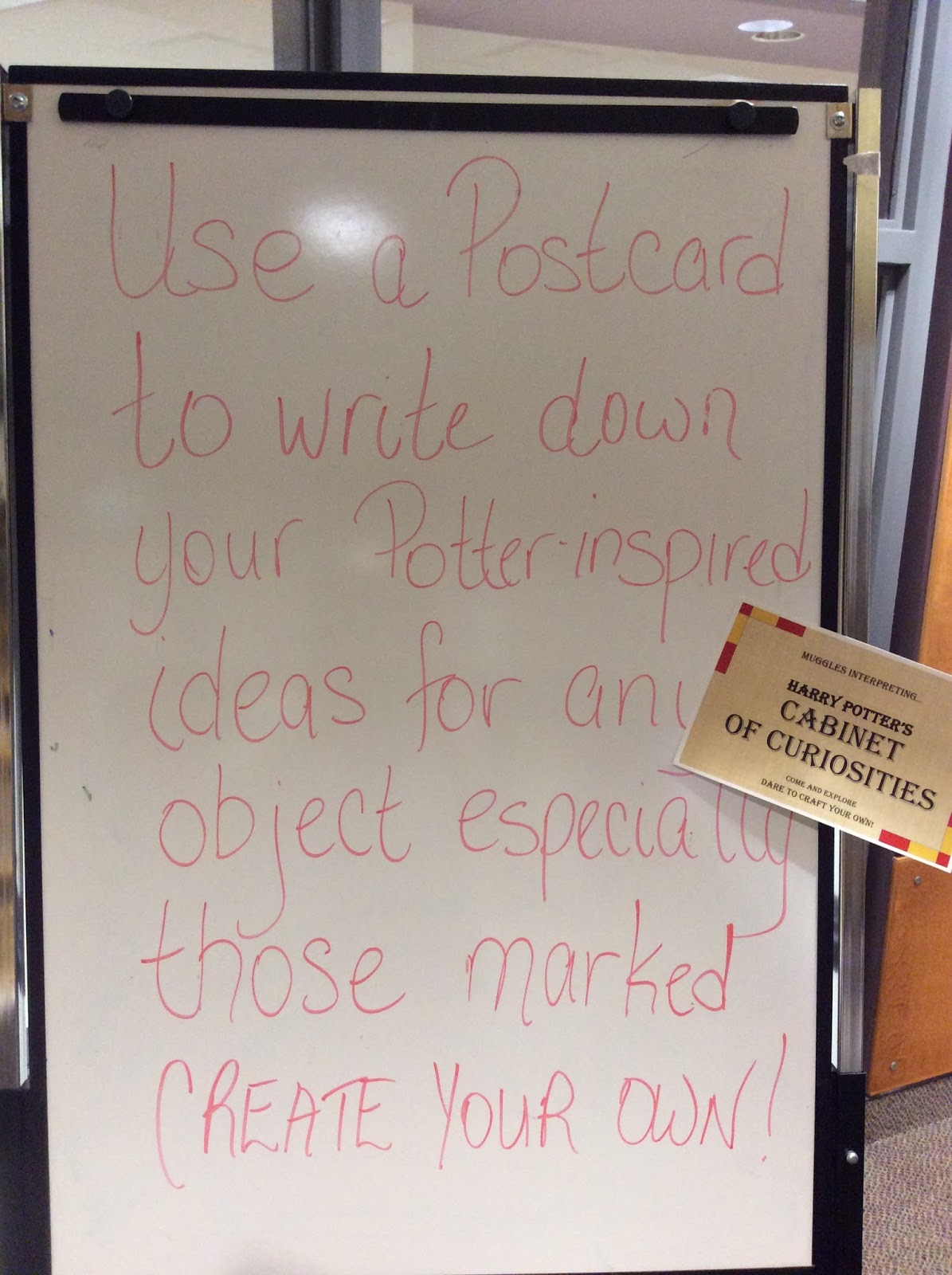
These are just a few of the 83 items that populate these giant knick-knack boxes. But not all of the artifacts have write ups. A number of them invite students to create their own Harry Potter-esque descriptions. Postcards are supplied and welcomed.


Besides being a fun display to welcome students, showcase some of the Doucette’s resources and celebrate the Harry Potter 20th anniversary, this also becomes a way to demonstrate to student-teachers ways of using space within classrooms. This type of display could be replicated in a school classroom, artifacts derived from home or school and children encouraged to use their imaginations to create their own magical devices.

If this does appeal to you, you should visit Pop Goes the Page – Muggle Studies 101  to see the artifacts and backstories curated for this Harry Potter Museum. It was reading an article about this exhibit that inspired me to try for something similar but on a smaller scale. Being on the smaller side makes for a perfect tie-in to how we like to inspire our student-teachers with possibilities for their own classrooms.


This corner of the library has been a “paint corner” where students were invited to paint on the glass window with acrylic paints. This was a total hit!


Also, we set the area up as a relaxing tropical ‘beach’ with comfy beach chairs, fake palm tree and sun, beach towels, sunglasses and the piece-de-resistance, crashing wave sounds (sound machine). This was to encourage students to take a few minutes to kick back at a very busy and stressful time of year.


We’ve got a few more ideas to try out in this corner of the library over this next academic school year.

Stay tuned!

Monday, May 1, 2017

Peace Bridge

Today’s recommended title will be of particular interest to Calgarians, Albertans and Canadians.


Bridges: an Introduction to Ten Great Bridges and Their Designers by Didier Cornille introduces us to 10 bridges from various countries spanning the globe providing a brief entry about the architects who designed them and sometimes a little about the construction process.  Each bridge has a something distinct about it, whether it was for a new construction process, a new design, extraordinary length, or a design feature.

Among the selected few is Calgary’s own Peace Bridge designed by Santiago Calatrava (2012).

The other bridges include:
Iron Bridge designed by Thomas Farnolls Pritchard (England, 1779)
Brooklyn Bridge designed by John Roebling, Washington Roebling and Emily Warren (United States, 1883)
Forth Bridge designed by Sir John Fowler and Sir Benjamin Baker (Scotland, 1890)
Plougastel Bridge designed by Eugene Freyssinet (France, 1930)
Sydney Harbour Bridge designed by John Jacob Crew Bradfield (Australia, 1932)
Golden Gate Bridge designed by Joseph Baermann Strauss (United States, 1937)
Rio-Niteroi Bridge designed by Jean Muller (Brasil, 1974)
Millau Viaduct designed by Norman Foster and Michel Virlogeux (France, 2004)
Mucem Footbridge designed by Rudy Ricciotti (France, 2013)

Each entry is very brief. I love the format of the book, which is oversized and read turned on its side so we are flipping the pages up. This is great for giving the reader a sense of length, giving the illustrations of each bridge lots of room to span the page. The details usually include a little information about the designer including other projects they’ve been involved in and most often specifics about the construction process.  The illustrations are simple, uncluttered and placed on pages with lots of white space.

The entry for the Peace Bridge in Calgary features several of Calatrava’s other structures giving only two short pages dedicated to the Peace Bridge itself. However cool looking this bridge there is not a lot of information about it in terms of construction.

Another thing I noticed is that with the exception of Emily Warren, who stepped in when her husband died building the Brooklyn Bridge there are no women featured here. There have to be some noteworthy bridges designed by women, right?


This book will be of interest to teachers for science (building things, designing), STEM, and social studies (Alberta, Canada, local politics). I would recommend this for middle grades.

Monday, January 30, 2017

The darnedest things


Weird & Wacky Inventions by Jim Murphy is a gem.

I’m wrapping up January’s design thinking blitz with a focus on the fourth phase – prototyping.

 (If you’re just joining us and wondering what design thinking is please visit the blog DoucetteEd Tech and read the last couple of weeks blogs to learn more. Here's the link to Paula's blog where she's review some resources that fit with the prototyping phase.)

Prototyping is about producing a product that can be tested in the real world to see if it fits with the need that was initially deemed worthy of investigation in the first place with an eye to improving the situation.

 So back to Jim Murphy’s Weird & Wacky Inventions.

One of the things that make us human is the ability to solve problems and in this book, the reader is introduced to a myriad of inventions and the associated problems. These devices were all patented in the United States going all the way back to the early 1800s.
The information is presented as a quiz; there is an illustration of the invention with a wee bit of description about what the device might do or the problem it might solve. After you make a guess you turn the page and learn what is really was for.

For example, here’s one that cracked me up:


The answer is # 2(of course), a sunbather’s toe-ring. This was designed to in 1973 by Russell Greathouse to help with the problem of uneven tanning. His toe-rings looped around the big toes and prevented the legs from splaying outwards thus resulting in the unsightly appearance of uneven tan lines. The flower was purely for aesthetics.  He’d thought of everything.

There are so many more inventions highlighted in the book that are ingenious, ridiculous, and amazing in their own ways.  Having students browse through this will certainly give them a very good sense about idea generation and that in the prototyping phase of design thinking everything is on the table for consideration. Nothing is too crazy. You never know when a bit of one idea meshed with something else will give you an outcome you wouldn’t have come up with in any other way.

The format is very approachable and easily read, great for dipping into and browsing. The illustrations have an old-fashion quality to them which I liked but may not appeal to students. Nevertheless, I’m recommending this for upper elementary, middle grades and struggling readers in high school.


Any guesses?

(Tell me what kid wouldn't be thrilled with a pair of jumping shoes with strong springy steel legs that would allow kids to jump farther? My track and field days would have been soooo different if I'd had these. Designed in 1922 by May and George Southgate.)

Monday, November 28, 2016

Writer’s block at the starting gate

I’m starting today’s post with a, “When I was in school...” story.

When I was in school, I dreaded hearing the teacher tell the class that today was the day we were going to write a story. That we’d use our imaginations to write stories about fabulous places and interesting characters doing who knows what. No sooner were the words spoken and I was panicking because every thought I might have had was gone.

Blank. Zip. Nada.

But maybe if I’d been given an idea to start with, say an open ended scenario, a stimulating
picture, a pertinent or perplexing prompt then maybe, just maybe, I wouldn’t have felt so lost.

Once Upon a Line by Wallace Edwards is one such book to provide story starters for struggling writers. It has a clever premise that every story begins with “Once upon a line”, line referring to the first sentence of the story as well as a physical line used in illustrating this picture book. Wallace presents the reader with the challenge of finding a very particular shaped line that is found in each illustration. (See image below.) I did find this challenging. Kids might like this component more than I did.

But I can see this book being particularly useful as a classroom tool for getting students to come up with some pretty intriguing stories. The format is a one page illustration, captioned with “Once upon a line,” and then an open ended statement that connects to the illustrations and needs to be finished by the reader.

For example, “Once upon a line, there was a knight who was allergic to horses. This was not a problem because…” is paired with an illustration of a trio of medieval knights riding into battle (maybe?) but one of them is sitting on an octopus.

Or

Once upon a line, Captain Kurd grew eager to sight land. If he didn’t find land soon, he was going to have to…” which shows a small boat with two mice holding musical instruments and the captain who happens to be a chunk of cheese searching for land using his eyeglass.

The illustrations are nicely composed with fanciful and sometimes humorous images that will help struggling writers construct their stories.  Still, lots is left for the imagination to get a work out but the pressure for creating the original idea is eliminated.

Other picture books to check out for story starters are:

Fish on a Walk by Eva Muggenthaler (lots of surreal images and only two word prompts to get a story started)

Breakfast on a Dragon’s Tail by Martin Springett (interesting illustrations with a good chuck of a story provided and a couple of questions to help spark ideas) and finally,

The Mysteries of Harris Burdick by Chris Van Allsburg (my personal favorite, a classic picture book with a single super realistic, surreal illustration and only a single sentence to spark the reader’s curiosity.)


I’d recommend these books for upper elementary and into junior high.

Monday, November 21, 2016

If it’s broke…keep on breaking…

In last week’s post, I recommended a book I thought would be a great fit in an elementary, STEM classroom.  This week I have another book that would also work well in a STEM or STEAM classroom but would work across many grade levels.


Things Come Apart by Todd McLellan falls into the coffee table book category because the photographs are so provocative and will appeal to a wide range of ages.  The premise of the book is looking at all the parts of everyday appliances, mechanical devices and constructed objects. For example, let’s say you’re keen to know about the inner workings of a mechanical pencil or a 1928 mantel clock or a 1964 Smith-Corona typewriter or a 1912 upright piano or a 2002 iPod 2 or a 2012 two-seater light aircraft (you get the idea, a range of things over several decades) or what it’s made of, then this book is for you.

All of these devices (plus 44 others) are entirely disassembled by the author. Every single piece, from the smallest screw to the largest casings are included and arranged in very attractive layouts (my favourite is the 1960s accordion) on one page and with a corresponding page showing all the parts falling through the air.  The piano and airplane are the exceptions and have pull out spreads to show us the entirety of their discombobulated glory.

So what’s the value of this?

In the field of education, you may have become aware of the Maker Movement. It’s all about getting children back to using their hands to create things both low and higher tech. (Think origami paper cranes to clothes that are programmed to light-up.) But if you think about creating something or exploring an idea then it’s sometimes really useful to think what the opposite of this thing, idea or process is (in this case, deconstructing) as a way to develop a different understanding of the object, idea or process.

(If you’re keen to read more about the Maker Movement go to Paula Hollohan’s blog, Doucette Ed Tech to see additional resources and information.)

Included are five essays by experts in various fields who explore the idea of taking things a part or putting them together or how repairing, reusing or repurposing objects touch on sustainability issues. These essays are more for an adult level or senior high level student.


So, go grab those old toasters, computer printers and TVs that are sitting idly in your basement or garage. Let a new journey begin with loosening a screw or two. What are you waiting for?

Monday, November 14, 2016

Live and learn - wool sweaters can shrink in the wash.


Though Funny Machines for George the Sheep by Geraldine Elschner and Remi Saillard is a book to introduce elementary students to the genius and inventions of Leonardo da Vinci, it is one with potential for more than just that.


First, meet George.  He’s a sheep.  He’s a sheep with a problem. His problem is shrinking to the size of a mouse every time he gets wet when it rains. When the sun comes out – phfff! – he’s big again.  Leo, the shepherd, resolves to find a solution to help George with his problem.

After stocking up on the various implements he needs to begin designing his new invention, we see Leo’s struggle to come up with a device that will help George. Eventually he settles on an umbrella shaped like a tall pyramid. Great design but there’s a flaw.

The first big gust of wind to come along whisks poor, old George off into the wild blue yonder. Seemingly unperturbed, George enjoys his aeriel view of the countryside and better still, the image of a pretty female sheep composed of fluffy clouds.

And, Leo?  He’s back at the drawing board looking for a way to find his lost, high-flying sheep.

The devices or machines that Leo devises are all based on Leonardo da Vinci’s designs which we can learn more about from the back of the book. Included are the self-propelled car, the army tank, the ornithopter, the paddleboat and the pyramidal parachute. Additional information is included about da Vinci, his genius and his inventions.

The book itself is OK. It’s been translated from French which I think accounts for some of the clunkiness. The ending is pretty abrupt with no resolution other than Leo happily dreaming up some invention to help him find George with oddly, no sense of urgency. I guess George will be found all in good time. I like the cartoony illustrations which have a European flavor and depict a landscape that remind me of paintings of northern Europe – Holland or northern France, maybe. 

What I really like about this book is it's potential in a STEM classroom as a way to introduce the concept of design thinking, innovation, problem solving, and perseverance.

In design thinking there are five stages of development starting with fully understanding the problem (empathy). Leo is in a position to learn all about George’s problem and why it needs to be fixed.  The second stage is defining the problem more fully leading to step three where the designer begins coming up with ideas, all sorts of ideas with no limitations (the crazier the better) that might begin to address the problem.  These two stages are represented in the book as Leo begins working out and drawing up plans for different machines. The last stages are more concrete, as a prototype is constructed and then further refined as the designer gets feedback on the suitability of the final product.

Does Leo construct a device for George that works at keeping him dry? We never do find out as George remains missing in action and the book ends. But this provides an opportunity to have your students take up the challenge and come up with their own solutions to prevent George from shrinking every time it rains.

If you’re interested in learning more about design thinking visit the Doucette Library’s library subject guide. Also, visit the blog Doucette Ed Tech written by my colleague, Paula Hollohan. I’ve linked to the tag for design thinking.

Template Design | Elque 2007