Showing posts with label photographic books. Show all posts

Monday, June 4, 2018

Inspirational Photos Instilling Wonder While Teaching


In looking closely at the three books I’m blogging about today, I realized that there was a connection between them going beyond the fact that these are all coffee table books filled with beautiful photographs. The connection is that these beautiful books engage our imaginations, opening up the worlds they present to us, provoking questions, instilling wonder and informing us, along the way.

First up is a book published by National Geographic, Stunning Photographs compiled by Annie Griffiths. As soon as I mention National Geographic, you’re assured that this book will not disappoint. Divided into six sections, Mystery, Harmony, Wit, Discovery, Energy and Intimacy, the photos in each embody some sense of the section’s title. I especially enjoyed the section, Wit as there was a great deal of humour and playful tweaking of our perceptions in these pictures. Really lots of fun. There are hundreds of pictures in this book, created from every corner of the world, I’m sure, and that will amaze viewers of any age.

My next recommendation is, Microsculpture: Portraits of Insects by Levon Biss.  I adore macro photography and this book is fantastic. Using preserved insect specimens from the Oxford University Museum of Natural History collection, Biss takes thousands of pictures of each insect and its parts and then reconstitutes them to give the viewer an amazing close-up. We get to see every pockmark, scale, whisker, hair, and ridge, plus an array of beautiful colours and shapes of 36 insects from various parts of the world. Each insect is given a short descriptive paragraph often discussing some weird feature and the importance of this particular adaptation. There are some amazingly bizarre looking creatures out there. When thinking about the number of science fiction and fantasy movies  that incorporate ‘out-of-this-world’ looking creatures, designers need go no further than Earth’s own insect population for inspiration.


My last selection is Through Darkness to Light: Photographs Along the Underground Railroad by Jeanine Michna-Bales. This photographer recreated a 1400-mile journey, from Louisiana to Ontario that slaves may have taken when trying to escape to freedom. Based on her research, she went looking to document some of the areas that slaves and sometimes, those helping slaves escape, would have passed through but also convey the sense of what it might have been like traveling, mostly at night, through unknown landscapes, living in fear of being recaptured.  The photographs are not necessarily the most interesting as they’re often murky and show deeply shadowed forests, meadows, and wetlands. But taken in context of a fugitive running for their life, the book does convey the danger, fear, and beauty that might have been experienced. The accompanying essays also provide a lot of interesting information about the Underground Railroad. This book will be most effective in the classroom that is already studying American slavery and the Underground Railroad and would be an interesting companion book to novels such as Underground to Canada by Barbara Smucker, Crossing to Freedom by Virginia Frances Schwartz, and A Desperate Road to Freedom by Karleen Bradford.

I recommend all three of these books for all ages.

Monday, March 6, 2017

Handful of books

I’ve had a soft spot for this book, Hands by Boris Cyrulnik, photographs by Tiziana and Gianni Baldizzone for a really long time. I often try to find reasons to bring it into my various workshops. It’s a beautiful coffee table book with loads of photographs showing close-ups of activities that hands do every day. Listen to the how the chapters have been organized: Hands of Pleasure, Hands of Beauty, Hands at Work, Hands of the Heart, Hands of Ritual, and finally By Hand… There are many beautiful images here that I think have lots of classroom potential.


Beautiful Hands by Kathryn Otoshi and Bret Baumgarten is a recent picture book that does the same thing; it asks what things will your hands do today? Will they plant seeds? Or maybe plant ideas? Or touch hearts? Will they lift spirits? Or stretch imaginations? Will they reach for love? Or peace, truth, dreams? 
The illustrations are unique using brightly coloured handprints to create images of birds, flowers and butterflies.

Using these two books together in a classroom would provide opportunities to explore the concepts the books embody as well as the actions that these hands engage in. At the youngest grades in social studies in Alberta where the focus is on identity, family, school and community, self, uniqueness and belonging, these books will start conversations. They could also be mentor texts that model work that students can engage in. Having students photograph the activities that they, their friends and family members do every day allows them to develop an understanding about what people do.  Hands, also speak to an individual’s identity and uniqueness.

I love the idea of how we use the word "hand" and the images that come to mind: hands up, hands off, hands on, hand out, hand-me-downs, a hand up, hands on, handful, handy, helping hands, heavy handed, show of hands, ‘talk to the hand’, shaking hands with the devil. What others come to your mind? There is both play and power with these words and the images they create. Hands create but they also destroy. Hands can be loving but also hurtful. Exploring binary opposites is a great way to introduce a kind of tension in a unit that will engage students.

Other books that would tie-in beautifully with these book titles would be:


These Hands by Margaret H. Mason is a history lesson embedded in a warm story about an African American grandfather telling his grandson all the things he could (tie shoe laces, play the piano) and could not do (not touch the dough at the Wonder Bread factory). It’s a gentle story about the civil rights African Americans had to organize and fight for.


Nadia’s Hands by Karen English is about a little girl worried about what her classmates with think of her and maybe tease her about having mehndi designs on her hands in preparation for an aunt’s traditional Pakistani wedding. This story speaks to culture and identity, about being one's self and belonging.


Sister Anne’s Hands by Marybeth Lorbiecki is a favourite of mine. Again its set during the civil rights movement in the United States and shows how a beloved teacher (an African American nun) makes a teachable moment out of a cruel, thoughtless act by one of her students to show how small acts of hate can lead to the big acts of societal discrimination.


Hands & Hearts by Donna Jo Napoli is about a mother and daughter who have a fun-filled day at the beach. They enjoy playing in the waves and sand, building castles and swimming.  They also happen to use their hands to speak with each other. There are 15 words introduced in American Sign Language.


Hands by Lois Ehlert is brilliantly designed with a hand glove shaped book. It speaks to all the activities that the busy hands in this household get up to: Dad is busy making a bird house and Mom is busy sewing. The narrator is given his or her own work space and is taught some the skills that Mom and Dad use in their activities. This book connects with the maker mind set that is now being promoted in schools here in Calgary.


These are only a few that would work well at the elementary level. 

Monday, January 9, 2017

Let it snow. Let it snow. Let it snow.

Happy New Year, Everyone!

Calgary is ‘enjoying’ a winter-wonder-land at the moment; seemingly, arriving within a couple of days over the holiday break.

Lots and lots and lots of fluffy snow, everywhere.

This is the perfect time to bring out the picture books that are about snow.
April Pulley Sayre’s latest offering, Best in Snow would be one such book. 

I do love her books.

This one also includes stunning photographs which draws the reader into a simple poem that incorporates the beauty of winter while giving us tantalizing bits of information about snow.

First, the photos: really gorgeous. Her images capture the jagged edge beauty of frost and ice crystals perfectly; the soft, lightness of the snow itself as it gently but irrefutably accumulates or the way wind and light can make the air bright and sparkly as if filled with polished gems.

Secondly, the poem: With so few words, the author is able to create a landscape that becomes redefined by the snow. Woodland birds and animals are shown within this landscape, adding depth to her words as the reader sees how life goes on. Nothing is static. Warming temperatures change the qualities of the snow and shows that within the bigger seasonal cycles there are lots of mini-cycles, too.

And last, are the information pages at the back of the book that make this a terrific book for connecting science and poetry. Each line is given some explanation and shows us how important snow is and where it fits into the hydrologic cycle.

I highly recommend this for elementary grades.

Other snow books that I love and worth checking out, include:


Blizzard by John Rocco 
Red sled by Lita Judge


Snow sounds by David Johnson


Stay warm.

Monday, November 21, 2016

If it’s broke…keep on breaking…

In last week’s post, I recommended a book I thought would be a great fit in an elementary, STEM classroom.  This week I have another book that would also work well in a STEM or STEAM classroom but would work across many grade levels.


Things Come Apart by Todd McLellan falls into the coffee table book category because the photographs are so provocative and will appeal to a wide range of ages.  The premise of the book is looking at all the parts of everyday appliances, mechanical devices and constructed objects. For example, let’s say you’re keen to know about the inner workings of a mechanical pencil or a 1928 mantel clock or a 1964 Smith-Corona typewriter or a 1912 upright piano or a 2002 iPod 2 or a 2012 two-seater light aircraft (you get the idea, a range of things over several decades) or what it’s made of, then this book is for you.

All of these devices (plus 44 others) are entirely disassembled by the author. Every single piece, from the smallest screw to the largest casings are included and arranged in very attractive layouts (my favourite is the 1960s accordion) on one page and with a corresponding page showing all the parts falling through the air.  The piano and airplane are the exceptions and have pull out spreads to show us the entirety of their discombobulated glory.

So what’s the value of this?

In the field of education, you may have become aware of the Maker Movement. It’s all about getting children back to using their hands to create things both low and higher tech. (Think origami paper cranes to clothes that are programmed to light-up.) But if you think about creating something or exploring an idea then it’s sometimes really useful to think what the opposite of this thing, idea or process is (in this case, deconstructing) as a way to develop a different understanding of the object, idea or process.

(If you’re keen to read more about the Maker Movement go to Paula Hollohan’s blog, Doucette Ed Tech to see additional resources and information.)

Included are five essays by experts in various fields who explore the idea of taking things a part or putting them together or how repairing, reusing or repurposing objects touch on sustainability issues. These essays are more for an adult level or senior high level student.


So, go grab those old toasters, computer printers and TVs that are sitting idly in your basement or garage. Let a new journey begin with loosening a screw or two. What are you waiting for?

Monday, April 4, 2016

Coffee Table Book Roundup

If you’ve been reading this blog for a while you’ll know how much I love coffee table books that have lots of oversized, glossy photographs.  I promote them in my workshops for student teachers, across the grades as a way to engage students. Whether a student is able to read the text of the book is less important in my mind than as a way to get a person interested in the topic.  If they’re keen enough maybe they’ll ask questions or even attempt to read the passages related to the pictures.

I’ve always been fascinated with macro photos. If this appeals to you too then you need to check out Hyper Nature by Philippe Martin.  The photographs are stunning. He’s developed a special technique making digital photos that brings the entire image into focus.   Blurry backgrounds and foregrounds are minimal and the creatures are in total focus.  This creates very sharp, almost 3-dimensional images.

His work is primarily of animals, insects and plants, found in their natural habitats around the world. Each photo tells us the common and Latin names of the living thing and details about how he achieved the photo including light conditions.  He does not always provide the location which is a minor quibble. I can’t say enough about the amazing, brilliant images in his book.

With spring about to get fully underway in Calgary, more and more bird life is becoming prevalent in our backyards and parks – at least for us in the northern climes. Life-size Birds: the big book of NorthAmerican birds by Nancy J. Hajeski, is one book to consult if you’re into bird watching and looking to hook a younger person.  With 95 birds featured including songbirds, raptors, gamebirds, waterbirds, among others we get to see and learn about them up close. This oversized book tries to show the birds on a 1:1 scale. For the smaller birds this is pretty easy.  We get to see hummingbirds, tits, warblers and wrens as they fly, feed, nest and care for their young. The larger birds such as the pileated woodpecker, bald eagle, vulture and larger owls are often depicted in part on the 1:1 scale to get a sense of size and also include other images on a 1:2 or 1:4 scale to see the entire bird.  All four sides of every page has a size gauge (in inches) to help with the sizing. Each entry also includes details about the bird's physiology, habitat and distribution. There are a few ‘features’ that focus on nest, eggs, birdsongs, bills, migration and threats to species. It’s a fascinating book that would be great in a math or science classroom teaching about measurement, scale, ratio and proportion.  I recommend this for grades 5 and up.

I should tell you right up front that I don’t get any kickbacks from National Geographic for recommending their books. I promote them all the time as they really know how to pull these kinds of books off.  Their explorers go to amazing places, often having adventures while taking remarkable photographs of their subjects of landscapes, people or animals.

First up are Ocean Soul by Brian Skerry and PristineSeas: journeys to the ocean’s last wild places by Enric Sala. Both of these books focus on the richness, wildness and beauty of the oceans of the world but Ocean Soul really looks at the wildlife that abounds and those that are under threat whereas

Pristine Seas showcases similar environments as ecological landscapes. Both give us what we love in these kinds of books; lots and lots of beautiful, informative images with well written commentary.


My last recommendation is Bear: spirit of the wild by Paul Nicklen.  This explorer must have nerves of steel and a big lens or two to get such close-up photographs of polar bears, grizzlies, black bears and spirit bears. There are shots of him only a few feet away from the bears as he makes his photos. Interspersed throughout the book are many contributors offering their personal perspectives about bears and their place in their environments. This book mixes pleasure viewing the images and informative, personal narratives. The outstanding kind of picture book in my opinion and one that anyone can enjoy.

Monday, March 9, 2015

Surreal industrial landscapes to the culture of stewardship

Wasn’t I the lucky camper last week when I attended a talk by Edward Burtynsky at Mount Royal University?  The correct answer: YES!!!

Edward Burtynsky is a photographer who looks for patterns in human behavior that have a huge and lasting impact on the landscape.

Think about the huge open mining pits in Ontario, British Columbia, or Utah.  Or the oil fields in California that cover vast areas of moonscape-like terrain. Or areas he calls ‘urban mines’ that encompass colossal mounds of tires or pyramids of stacked cubes of crushed scrap metal.

None of these are landscapes that I’d go looking for to photograph. But Burtynsky’s work captures a terrible beauty while informing us about the undeniable impact humans have on this planet.  His photographs don’t chastise but let us draw our own conclusions about the need for oil extraction, water use, transportation and our methods of production, consumption and disposal of waste.

Cover:  nickel tailings, Ontario

Manufactured Landscapes, both the over-sized coffee-table book and the DVD, draw us into our world in new ways, giving us new perspectives, whether he’s at ground level or taking aerial shots.  No one would ever argue that these are small problems but seeing these images on such a large scale, certainly and scarily, brings home this point.

Cover: Xiaolangdi Dam, China


The book, Water is available in the Doucette Library as an enhanced e-book app. Many of the images included in this book, I was lucky enough see and hear the photographer discuss in his talk last week.  But as an app, you, too, can hear the artist as he speaks to the images.  The e-book includes pop-up maps and zoom capabilities, as well. This is an intriguing format which is worth a look, but for me, it took away from the images as an artistic statement.

One question posed by an audience member at the talk, was about how he keeps going after photographing these kinds of images for over 40 years.  There is a sense of being overwhelmed by how much humans take without real consideration for short or long-term impact.  He ended on a positive note; saying that he thinks we are moving into a time when we will become better stewards of the planet and sees young people, concerned with their own healthy living, becoming more aware of quality of air, water, and food when it impacts them directly.  They will become better advocates for the environment.

Using Burtynsky’s work in a classroom would work at many levels because the images are so compelling.  Reading level is appropriate for high school and up. The images could be used in a teaching context in upper elementary and junior high school.  The e-book version of Water where sections are read out loud would be a great advantage for struggling readers.  Great opportunities for integrating content areas connecting environmental issues with social, political, geographical and scientific thinking.


Monday, November 24, 2014

Visual literacy: Power of a photo


Right off the bat, I have to fess up to loving the series Captured History and Captured World History.

I've blogged about one of the books, Migrant Mother by Don Nardo a while back, in fact.
And I'm immensely grateful that the publisher (Compass Point Books) has branched out into world history with their latest offerings.

These books focus on iconic photographs that have had an impact on the viewing public, changing and forming public opinion about social issues such as migrant workers during the American Depression era, about child workers in the early 1900s,  the cost of war, specifically the American civil war, the environment, and international politics to name but a few.

They are organized following  a basic format:  rudimentary background about the ‘moment’ to set up the image,  in-depth historical information about  the period, information about the photographer, his/her work and what was happening when he/she took the photograph and then, what lasting impact the image has had. Also included are timelines, glossary, reading lists, internet resources, bibliography, index, and a few critical thinking questions.

These real-life stories really get you into the picture you’re looking at, establishing context so that we can understand why the photo was and often still is important and what were the implications for social change.

So, have I convinced you that these series are worth checking out?


Another recent arrival in the Doucette Library is PhotosFramed: a fresh look at the world’s most memorable photographs by Ruth Thomson.

It does a similar job focusing on notable images (27 of them to be precise).  These are organized into groupings according to the intent of the photo.  Categorized as portraits, nature, art, and documentary,   each section displays several photographs that range over time.  For example, Portraiture includes an 1844 image of Louis Daguerre who produced the first permanent photograph, a 1949 of Pablo Picasso, Che Guevara in 1960, Afghan girl in 1985, and the Royal Wedding of Prince William and Kate Middleton in 2011.

Each photo is accompanied by a preceding page that contains information about the photograph, the photographer, two boxed commentaries that zoom in on very specific aspects of the image, and three questions to make the viewer think a little more deeply about this image.

For example, when viewing the famous National Geographic 1985 photo of a refugee Afghan girl we are asked to think about:
*How does the girl’s direct stare make you feel?*How might the effect of this photograph have differed if the photographer had taken a wider shot?*If you had to put this photograph into a category, with would you choose: portrait or documentary or both? Why?

I found this book fascinating because it did include so many images, many that I was unfamiliar with, so I could browse.  The point of memorable images is that they draw you in, make you wonder what the story is, and then revisits you time and again.


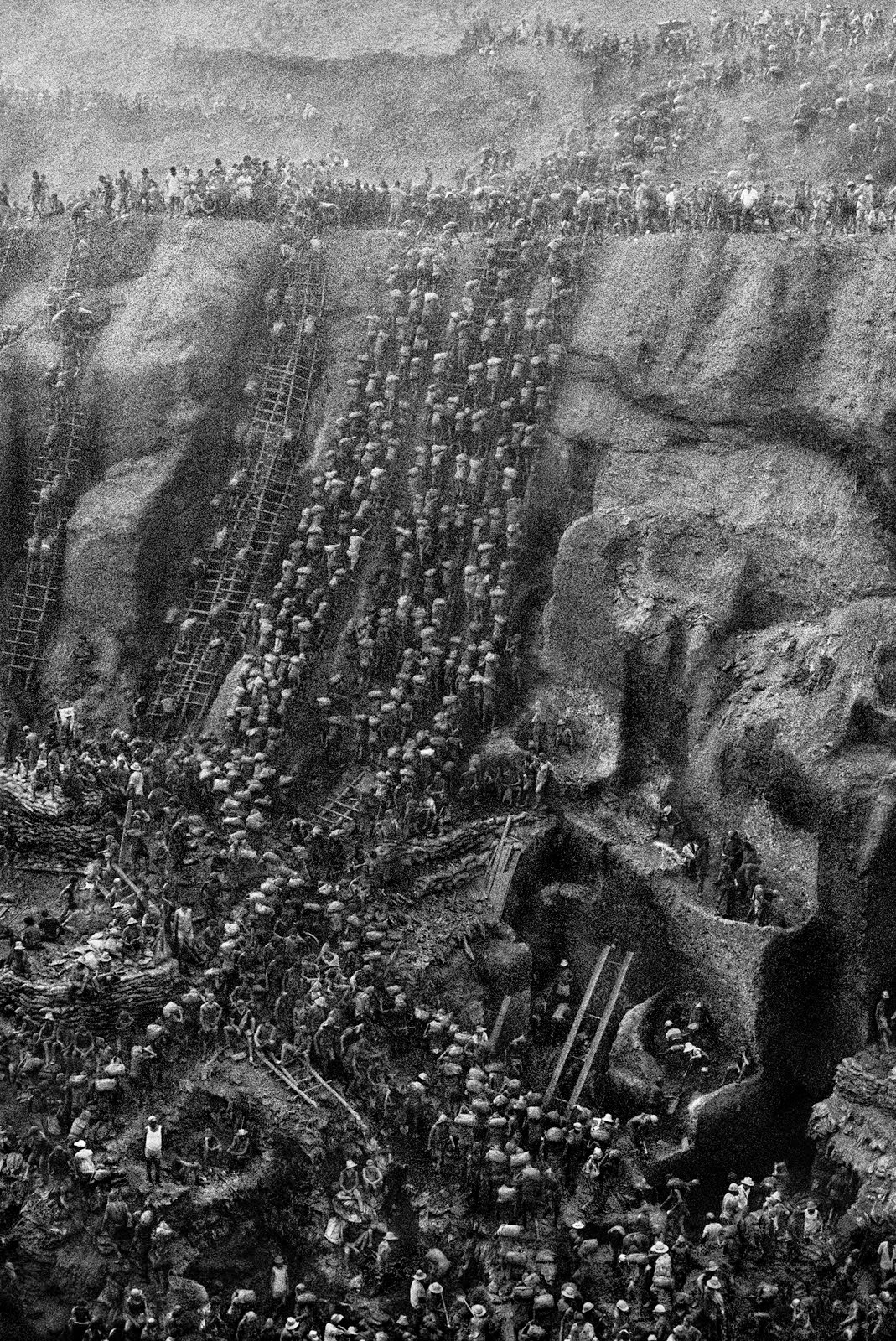
Take the 1986 photograph of the Serra Pelada gold mine taken by Sebastiao Salgado (pp.52&53) that document
 the enormity of the man-made mine, with carved-out hollows and terraces and long, rickety ladders leaning against its steep sides.  The packed crowd of miners, shifting their loads of earth, appears to move as one, in a continuous flow, like ants.It is an evocative image.

There is some overlap between the Capturing History series and Photos Framed which I found interesting and great for comparing the two.

Check out Tank Man: how a photograph defined China’s protest movement by Michael Burgan and p. 54 and 55 in Photos FramedTank Man  (the book) is full on – everything you need to know.  Photos Framed is much more cursory with just the basics for context.   The questions posed by each are interesting and, I think, complementary.  Photos Framed gives us three questions that make us analyze and deconstruct this specific image whereas Tank Man provides questions that take us beyond the image having us think about the implications, like the attitude of the protesters, understanding aspects of democracy, and the power of such an image.

I’m recommending both books for the middle grades (grades 5-9’ish) but I think students in high school would find these fascinating and very approachable.  Students working below reading level might feel less daunted but still come away with an increased understanding about significant moments in history and today’s world.


Monday, October 13, 2014

Things we’re thankful for


Toy stories : photos of children from around the world and their favorite things by Gabriele Galimberti offers an unusual way to enter into the lives of children from around the world (58 countries) giving us insights into their lives, interests and those of their parents too, as it turns out.

The compositions are fairly straight forward.  Typically the child is centred in the photo with their toys (or toy, as the case may be) splayed out around them.  The preceding page offers their first name, age and the country they live in.  Sometimes there are lots of objects, sometimes only one.  It’s fascinating to see what is deemed a ‘toy’.  The ones you’d expect are there:  animal stuffies, all manner of vehicles, dolls and Barbies, a myriad of plastic figures and animals, a few bikes, a few games (both board and video).

 But the picture with Maudy (3, from Zambia) standing in front of a few dozen pairs of sunglasses is definitely unusual.  Apparently, a box of sunglasses fell from a passing truck and became toys, the only toys in this village.  They like to play pretend market. Or there’s Callum, 4 from Alaska, standing with a couple of shovels and sleds in a wintery landscape that also speaks to a very specific kind of interest in a particular kind of environment. 
A few children seemed keen on guns (a little scary), and I found only three photos where books were included (a little distressing).

You do see what you would expect to in terms of differences between affluent and poor families (more and less, literally).  But the introduction offers a couple of interesting perspectives about this observation:

“The fewer toys a child had the less possessive he or she was about them.  Galimberti describes having to spend several hours winning the trust of Western children before they would consent to let him touch their planes, cars, or dolls.  ‘In poorer countries, they don’t care as much.  They play in a different way, running around, sharing one ball between them all.’ … Likewise, children who enjoy a free-roaming existence in the countryside seemed to place less value on their toys than children living in busy cities, confined and isolated.  ‘City children mostly stay inside, and mostly play alone, ’he says.  ‘They tend to have a lot more toys and to be a lot more possessive.’”
The short introduction is well worth reading.

Using this book with Material World by Peter Menzel and/or Much Loved by Mark Nixon would make an interesting threesome.  Though all three don’t have to be used together, pairing at least two of them offers a classroom teacher a visual way to explore material culture on a level that kids could easily relate to.  Looking at their toys and finding out what they mean to them and then looking at how other children live might make the conversation about quality of life more comprehensible.  


Happy Thanksgiving everyone.

Monday, June 16, 2014


The Art of Clean Up: life made neat and tidy by Ursus Wehrli is a very funny and very clever book.

I can’t say that I think the idea of tidiness or cleaning for a children’s book would be all that relevant or of interest.    But after going through this very quirky book, I’m willing to change my mind.  I think it will hold and engage almost anyone.

Ursus Wehrli , besides being uber-organized, is a typographer, a comedian, live performer and freelance artist.  His humour and penchant for ‘tidying’ things is played out with flare in this book.

Let me give you some examples.   On each set of facing pages we are given a photo of a fairly commonplace scene from everyday life.  Clothes hanging out to dry, a child playing in a sand box, an aerial view of a car park or a school ground with playing children, a bouquet of flowers, a decorated Christmas tree or a pile of pretzels to give you a range of the mundane and ordinary that we surround ourselves with.
But if you were to take the ‘chaos’ away from each of these and prettied them up, life would be less jumbled, way more orderly and colour coded to boot.

Clothes on a clothesline would be grouped according to colour and displayed rainbow-like.   The child playing in the sandbox with various plastic toys, would now be sitting (and no doubt marveling) at very neatly arranged rows of pails, rakes and shovels, sieves, watering cans, sand molds and dump trucks displayed on freshly raked sand.   The messy mound of bent pretzels is now shown as two rows of straightened, salted snack food.  Who knew that a Christmas tree ‘broken down’ into its component parts would equal a pile of needles, a bundle of kindling, one stand, a coil of tinsel, one pointy tree topper and several rows of red and silver round ornaments, hooks and lights?  Kind of takes the romance away, but that’s what makes it funny.  It plays with our expectations.  Now if only I could get my decorations to look even half as neat.

It becomes somewhat of a game trying to see all the components between the before and after pictures.  Take a look at the book cover above. What are those white dots lined up with all the various pieces of fruit found in a bowl of fruit salad?  Why it’s the polka dots that were on the bowl, of course.


Besides the visual humour factor, I do think there could be some classroom application when it comes to pattern making and observation skills.  This isn’t the book you’d use to introduce young children to the concept of patterns in the earliest primary grades. But older children will be able to work things out.  Might be a book that you can model your own attempts to tidy up and get organized once and for all.  Not a crucial resource but one that is lots of fun.

Monday, April 14, 2014

Holiday break

University is winding down for another academic year which means I’m heading off for a holiday.  I don't know about you but it feels like this winter has been never-ending.

But wait!  Before I go, I have to share a little story.

Just a couple of days ago, a co-worker brought the book The Underwater Museum: the submerged sculptures of Jason Decaires Taylor to my attention.  Loved it!

It’s a surreal but amazing look at the work of this artist who casts life-size human models (using real people) to create sculptural pieces that he then sinks off the coast of Grenada in the Caribbean and various places along the coasts of  Mexico.  It blends an artistic statement with a way to encourage reef development.  The three essays at the front of the book, one by the artist himself, Carlo McCormick an art critic and curator and finally, from a scientist, Helen Scales about reef conservation and the importance of healthy reefs to the environment offers different perspectives showing the relevance of such a project.

The book showcases a great blending of art and science.  Check out the website to find out more about the artist and the project.  I think anyone would find this fascinating to peruse. 

And, guess where I’m going?  Don’t say Mexico.  In looking for an off-the-beaten-track spring adventure this year we chose Grenada.  I love how serendipity plays out sometimes.  To find out about this underwater museum just before I go is just too auspicious and I’ll be making the most of this opportunity.

I’ll be back in May and will start posting again in the middle of the month.


Monday, March 10, 2014

Coffee table books round up

Even though I haven’t been blogging very much in the past few weeks rest assured that I’m always busy reading or at least looking at books with lots of pictures.

Thus today’s topic – coffee table picture books.

I’m a big proponent of these books as the best of them are typically, beautifully produced, informative and often give us mini-narratives about the photographer’s work, adventures and views on a given topic.

Let’s start with Dawn to Dark Photographs: the Magic of Light by National Geographic.  I can’t think of a single National Geographic book that has ever disappointed me.  Always stunningly beautiful photographs arrayed in thoughtfully produced books.

In Dawn to Dark Photographs, the photographs are sorted into eight sections based on time of day starting with dawn, then into sunrise, morning, midday, afternoon, sunset, twilight and then night.  Most of the photos are of landscapes and specific natural phenomena with a few showing people or animals.  In terms of classroom use, I was thinking about the obvious connections with the elementary science units about light and shadows, time, animals, as well as with photography as an art form for any level.  What I hadn't thought about was the meditative quality of the book.  Jim Richardson in the preface reminds us that photographs can resemble medieval meditations (think illuminated texts like the Book of Hours) as we pause to look and reflect on “the miracle of light and appreciate its infinite and astonishing variety”.  Every few pages we get a short passage written by the photographers about their picture: what they saw and experienced and maybe tried to capture in their image.  Or we are given a short poem, quote or thought that ties into the adjacent photo. 

India: In Word & Image by Eric Meola obviously connects to the grade 3 social studies curriculum which looks at life in India.  What totally blew me away was the overwhelming sense of colour.  Even before getting to the title page our eyes are bombarded with achingly vibrant colours.  Besides being richly coloured, the photographs capture the exotic and textured landscapes and architecture of India.  Images of people are captured individually or in groups in moments of celebration and everyday activities.  I’m not sure if it’s just me being caught up with the myriad of patterns and colours of saris or the photographer’s keen interest, as many of the pictures depict sari-clad women.

The photographs are anchored between passages, often selections taken from novels, written by authors who are Indian, of Indian descent, or who write about India.  The passages are appropriate for high school level and up but the pictures will engross any age.

And, finally I’m recommending Relics: Travels in Nature’s Time Machine by Piotr Naskrecki. This one has more text than the other two making it appropriate for high school reading level and up or perhaps for students who are super keen on palaeontology and willing to make the effort.  I didn't find the information difficult to digest; it just seemed a little dense and might be intimidating to less-than-proficient readers.  However, Naskrecki does include lots of vignettes of his adventures, which read like little mini-stories and he certainly conveys his passion and excitement.

But it's the great pictures that will get students into the book.

This entomologist is also a fantastic photographer who travels the world looking for animal and plant relics found in nature.  “Living fossils”, relicts and relics all refer to those species of plants and animals that can be linked to similar organisms in the fossil record.  These are modern plants and animals that can provide insight into genetics, habitats, adaptations and behaviours of ancient species.  Some of these include horseshoe crabs, legless lizards, various tree frogs, toads, caterpillars, ferns and fern-ish looking trees known as cycads, magnolias and so many more.

One critter of particular interest is found in the Rocky Mountains close to Calgary.  Ice crawlers are insects that live in ice caves or on northern talus slopes up to about 3,000 meters, who like it cold but not too cold (0 to -9 degrees Celsius).  You can kill an ice crawler by merely touching it because of our warm body temperatures. Very cool little critters.  Again and again, I flip through pages and see yet another fascinating animal and another and another…

Classroom connections again would lean to environmental science, art and language arts.


Thursday, January 30, 2014

Move over Knufflebunny and Velveteen Rabbit.

There are a whole slew of new kids in town.


Much Loved : photographs by Mark Nixon is a wonderful book that I'm very pleased to add to the Doucette’s collection.

This is a photo album showcasing 65 beloved ‘stuffies’ ranging in ages from 104 to 5 years. The portraits of bears, bunnies, puppies and one giraffe are accompanied by stories that gives varying accounts of the toys’ arrivals, departures and missing-in-action adventures. 

The real power of the book lies in the love that comes across for each toy no matter how brief the narrative is.  It is so easy to make an emotional connection, either through our own childhoods or through those of other children, with these VBFsF (very best friends forever).  And I do mean forever.  Apparently, there are some very indulging husbands who let their wives bring their childhood stuffies to bed.

The portraits are simple, unadorned with only a grey background that lets us enjoy each of the stuffed creatures in all their ugly-beauty.  And some of them really are not much more than tattered bits of cloth, knitting, bandages and fake fur tenuously being held together with thread and memories, I think.  If you’re going to lose your fur, then having it kissed or rubbed away are probably the better ways to have it go.

The actor who played Mr. Bean, Rowan Atkinson also included the bear used in the Mr. Bean series, Teddy, describing the significance the toy had to the character. 

One of stories that made me chuckle was about a newborn being joyously brought home by proud parents, ensconced in his crib and unbeknownst to the mother, tucked in by dad with a ‘manky Ted’ (a handmade teddy bear the husband got when he was born, now very grubby and badly stained by who knows what and I suspect, maybe a little smelly to boot) “beside my pristine newborn! I banished Ted to a shelf in the bedroom, where he now happily stays.” I love it.  I can see how the whole thing played out.

There’s Patsy and Floppy who are two very bedraggled animals, indeed. But the wear-and-tear they've endured is the testament of being well loved and are all the cuter for it.  These stories bring a tear to the eye easily enough.

One of the stories I found very touching was about Johnny’s bear, Mr. Ted.  Johnny was immediately besotted with the bear and went with him everywhere.  Unfortunately, Johnny died just before his sixth birthday.  His younger siblings were born after his death but played with ‘Johnny’s bear’ while growing up.  He too, bears evidence of being loved well with patchy fur, a couple of tears and replacement eyes.  This story is accompanied by a poem Johnny’s mom wrote about Mr. Ted and his place in this family’s lives.

I can’t say I’m exactly clear on how I will introduce this book to student-teachers or which workshops I will bring this to, but rest assured that I will be trotting this one out every opportunity I can.  The artistry of the photographs combined with these narratives is too powerful to pass up.  Children will want to tell of their own beloved stuffies as well as adults.


Check out Mark Nixon's website to view some of the pages and images from the book.

Template Design | Elque 2007