Showing posts with label Nellie McClung Elementary School. Show all posts

Thursday, August 15, 2013

Awakening, the next ‘big idea’ OR, Muddling of the mind

Some of you may remember that every summer, at the end of August, before school starts, I present a book talk to a group of elementary teachers around a ‘big idea’ that they've selected to teach to K-6 throughout the year.  The principal calls it ‘a book talk on steroids’.  I think that’s good, right?

This year’s big idea is AWAKENING.

It’s big alright.

Every second kids book can somehow be linked (at least in my head) to this idea of awakening.

Here are a few of the ideas that I immediately came up with:
beginnings, epiphany, perceptions, fresh starts, awareness, new life (nature: spring/seasons, birth, hatching, blooming, budding, etc.) start of the day, new ideas, insight, understanding, enlightenment, openings/openness, revolution (political, Arab Spring).

Here are a few activities, actions, or thought processes I associated with awakening:
creating/creativity, innovating, activism, inventing, blooming, spontaneity, capturing imagination, opportunities, gaining perspective, tapping into the subconscious, critical thinking.

Here are a few of the opposites that I considered important to think about, too:
sleeping, decline/decay, shutting down/out, death(?, underworld stories), ignorance, worry/fear, narrowing.

Those are my thoughts.

When I received the planning notes from the teachers last June I found many of my ideas matched with theirs, which was a relief.  As well, I noticed that this year there was a lot more synchronicity between the grades compared to previous years.  The way I'm interpreting these notes is coming up with a focus on the internal processes of self awareness, mindfulness, living in the moment, awareness of others (as in community and society, local and global), empathy,
how the brain works, and well being. All of this somehow connects to developing meaning and purpose in one’s life.

Each grade also presents some specific ideas that more closely connect with the Alberta curriculum, current events, and Calgary, too.

So back to translating all of the above to books teachers can use in the classroom.  Well, there’s a lot that could potentially work.  Here are a few titles that I think will be solid additions in the classroom:

8th Grade Superzero by Olugbemisola Rhuday-Perkovich – Great choice for upper elementary that covers many of the aspects about awakening.

A Bus Called Heaven by Bob Graham K-3, a terrific story that will connect personal action with community.


The Evolution of Calpurnia Tate by Jacqueline Kelly. – For grades 5-8. An historical novel that explores the nature of gender, family and awareness of the natural world.

Have Fun Anna Hibiscus by Atinuke. – For grades 3-5.  Nothing like travel to ‘awaken’ one to how other people live and discover things about oneself at the same time.  An African girl comes to Canada to visit her grandmother for the first time.

Home of the Brave by Katherine ApplegateGrades 5-7.  Told in narrative verse, we too experience culture shock as a young Sudanese refuge figures out the complexities of living in a large American city.

I Know Here by Laurel Croza – For K-3 level about really knowing your home and community especially the physical landscape. (Canadian)

Love That Dog by Sharon Creech – For grades 3-6.  Another story told in verse that shows Jack’s deepening appreciation for poetry and how poetry gives him a voice and a way to handle life’s problems.


My Map Book by Sara Fanelli – K-2.  I'm pretty sure I've recommended this one before to the teachers at Nellie McClung.  I use it a lot in many of my workshops.  Works with the geographical thinking component of social studies as well as identity, family and what’s important in this particular child’s life.


Zen and the Art of Faking It by Jordan Sonnenblick – Another good choice for upper elementary that especially touches on identity, empathy and activism with a Buddhist kick.

Thursday, September 6, 2012

The End of Perspective

I spent a good part of July and August reading tons of books with the 'big idea' of perspective tucked into the back of my mind.  I presented the lengthy book talk to a group of elementary school teachers last week.

I've been involved with this school for the last several years, book talking resources focused around whatever big idea they select to teach for the whole academic school year across all the grades.  This is a great exercise for me but I must admit I'm glad to wrap up at the end of August, too.  I can now read more openly not in such a prescribed way.

But to wrap up this exploration, I thought I'd mention a few of the books that seemed to be of particular interest.

I started with the perspective that was closest to self.  How do I perceive myself?  How do others perceive me?   Single perspectives versus multiple views. Perspective that is biased or distorted versus perspectives that promote empathy or are non-judgmental.  There were so many good books to choose from.


 Wonder by R.J. Palacio and  Who is Melvin Bubble? by Nick Bruel  seemed to strike a cord with a couple of teachers. Both use multiple perspectives to explore who each of the main characters are.  Looking at distortions or bias is certainly relevant in each of these books.

My exploration of perspective broadened out a bit to look at community (in the biggest sense, Calgary, Alberta, Canada, and world) over time and place.  Two history books based on the lives of Canadians that attracted interested were The Duchess Ranch of Old John Ware by James Davidge and Fatty Legs by Christy Jordan-FentonThese two books would work well to show how attitudes change from historical to contemporary times. A third book, Mrs. Harkness and the Panda by Alicia Potter also looks at how things change over time. This particular book shows how our contemporary views about animal conservation have changed since the 1930s.

The next broader layer started to look at organizational perspectives (eg. corporate, media, technology, religion, government, etc.) and specific perspectives of particular disciplines such as art, mathematics, science, literature, history, psychology, philosophy, the natural world, etc.  This allowed me to combine perspective with the question about what is true/truth and how do we know when something is true or real.  Lots of layering of complex thoughts and more great books to recommend.  Here are a few examples:


Art Against the Odds by Susan Goldman Rubin and Just Behave, Pablo Picasso by Jonah Winter are different ways at looking at the question of who decides what is art.  The picture book about Picasso is particularly accessible for the primary grades, whereas Art Against the Odds will work better for older students.  Whether an artist is presenting something entirely new or in unexpected places (prisons, psychiatric institutions, African villages, inner city classrooms, etc.) public perceptions can make it difficult.


Looking at the way the media portrays, well anything and everything could certainly be a rich way to explore the idea of perspective.  The Great Moon Hoax by Stephen Krensky and Bat Boy Lives!: the Weekly world news guide to politics, culture, celebrities, alien abductions, and the mutant freaks that shape our world by David Perel are interesting ways to look at how news can be distorted to the point of being totally ridiculous.  


Related to this are two books in the series Captured History: Migrant Mother and Breaker Boys.  Each of these books looks at the power of photography, especially in the early 1900s.Photo journalism was something fairly new then and was a way for the American public to learn about dire social conditions for migrant farm workers during the Depression (Migrant Mother) and child labour in the early days of industrialization (Breaker Boys).  The motivations of the photographers and the techniques they employed to capture their images are discussed, as well as the context in which the photos became famous.  Both are excellent resources.

Along the same lines is The Big Push by Erika Wittekind that is a little book that accessibly lays out how we are constantly exposed to media messages,  whether in terms of advertising  pressuring us to buy stuff or informing us about current issues (supposedly news).  Because it's brand new there are many contemporary examples for kids to related to. 

The last one I'll mention is There is a Flower at the Tip of My Nose Smelling Me by Alice Walker that I actually read this aloud as an opener to my presentation.  It gave me a beautiful way to open the book talk about perspective in a 'backwards' way.  As the title suggests it is the flower that the narrator  holds that is actually doing the sniffing.  Or the ocean, sky, and sunrise that experiences the narrator rather than the other way around. Or a dance, story or walked dog connecting back to the narrator who becomes the object or the activity.  It's an interesting way to show an interconnection with nature and the artistic/creative sides to our world.  Poetic and beautifully illustrated, this book is a grand opener and presents perspective in a different light.

Any finally words about perspective?


Thursday, August 30, 2012

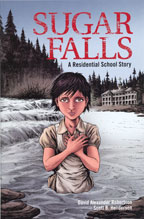
In pursuit of the big idea 'perspective', I've been reading many middle grade novels like a mad woman .  Last night I gobbled up Sugar Falls: a residential school story by David Alexander Robertson (823 R545S8 FIC).


This short graphic novel is a gem.  In 40 pages we come to know Betsy, a little girl taken in by a loving family after her mother abandons her. In time, Betsy's foster father tries to prepare her for  when she will go to a residential school run by Catholic priests and nuns.  He does not say "you will have to go to a residential school" but tries to warn her that a dark time will come and that she has the strength and resiliency to endure.  She must remember who she is, connections to her family, and her culture.

Betsy's time at the residential school is horrible, to bluntly understate it.  The teachers are cruel and abusive.   Betsy is slapped and kicked by a nun when she doesn't get her Latin right or speaks Cree.  Sexual abuse is touched on, as well, but not too graphically.  The priest enters the girls' dormitory at night and leads one of them away.  Betsy's friend Flora counsels her to close her mind, numb her body and pretend it was 'only' a nightmare.

The story is told from the perspective of Betsy as an adult.  She's telling her story to her niece and her niece's friend, who has been given a school assignment to interview a survivor of the residential school system.  Betsy has survived her experience and motivated her to become a  teacher of Cree and a language consultant.

Now back to perspective.  A couple of questions given to me to think about were What shapes our perspectives?  How do perspectives change over time [as in a historical context]?

I think Sugar Falls provides insight into both of these questions. An experience like the one Betsy lives through would certainly shape many aspects of her life.  Betsy's own mother had been through the residential school system and came out damaged enough to be unable to care for her daughter.  These are defining moments without a doubt.

Also, we can make comparisons between contemporary times and times when residential schools  were prevalent in Canada (roughly 1840s to mid 1990s).  Historically,  it was government policy to look for opportunities that would 'civilize' First Nations peoples. Removing children from their families and communities was one way that they could be Christianized and 're-educated' to be more white and less 'savage'.  Today this policy is unconscionable.   

For the teachers of Nellie McClung Elementary School this might be a book to consider.  They had asked me for books about residential schools.  This one may not be appropriate for their purpose but I will let them decide.  Unpacking this with their students will take some work.

Other books that may be less contentious are:
Fatty Legs by Christy Jordan-Fenton
Shi-shi-etko by Nicola I. Campbell
Shin-chi's canoe by Nicola I. Campbell
My Name is Seepeetza by Shirley Sterling.

Thursday, August 23, 2012

The Big Idea – Perspective.


This really is a great topic and I'm making the most of this opportunity trying to find different perspectives or characters who represent different perspectives.  To clarify – that would be perspectives different from my own.  This is one of those topics where individuality plays a significant role. (If you don’t know why I'm writing about perspective go to July 5th’s blog. )

A common question  the Nellie McClung Elementary School teachers came up with, was--

What's it like to walk in someone else’s shoes?

The purpose of most stories is it give the reader some kind of insight into the lives of other people. So, short of pulling almost all the books off the Doucette Library's shelves, I'm trying to be a little more controlled and selective in the books I'm recommending.

I’ve already mentioned Wonder by R.J. Palacio  that captured both my imagination and my heart.  Along the same lines is Out of My Mind by Sharon M. Draper (823 D791O FIC). Melody is in grade five but faces additional challenges with cerebral palsy.  I really liked this story and particularly enjoyed the character and voice of Melody.  I felt as trapped as she did in her own body, looking to live life like ‘normal’ kids.  She has tremendous spirit with an upbeat outlook, great sense of humour and bunches resiliency.  When she is given the ability to communicate through a computer device, and her world opens up, I felt like I was able to communicate again.  This is a strong story that brings us into Melody’s world. We learn what it’s like to live with severe, physical restrictions and how to go about living the best life you can.  Both Wonder and Out of My Mind place readers into the skins or ‘shoes’ of two unique souls and will help students emphasize with someone else’s lot in life.

Trash by Andy Mulligan (823 M9165T FIC) was an interesting read that took me into a community that lives by and from a vast garbage dump in a Southeastern Asian urban centre.  It is told primarily from the point of view of three boys who live and work at the dump.  This is a mystery that revolves around a package that one of the boys discovers that leads them into heaps of trouble as they help to expose a corrupt official. Eventually they have to leave the dump and their families to start new lives. The action and tension slowly builds, drawing you through the book. The conditions in which the boys live are mind blowing and told in a very matter-of-fact way.  Though a work of fiction, it is based on an actual garbage dump and the people who work and live there in Manila.

The Other Half of My Heart by Sundee T. Frazier (823 F8698O FIC) is a beautiful exploration of sisterhood.  A pair of twins of interracial parents gives us the opportunity to think about identity, belonging and how race plays into both.  A beauty pageant for black girls is the setting where sisters, light-skinned Minnie and dark-skinned Keira, begin to see that the colour of their skin often dictates how people will treat them.  Told from Minnie’s point-of-view, she begins to understand how her sister feels when pageant organizers and contestants, assuming she’s white, suggest she doesn’t belong in the pageant.  Keira often feels that she doesn’t belong in their predominantly white community, experiencing racism that Minnie doesn’t have to deal with.  Minnie is a very thoughtful girl and the set of circumstances she finds herself in allows her to grow and become stronger.
I’ll be recommending each of these three fabulous stories to the teachers from Nellie McClung Elementary School

Thursday, July 5, 2012

The Wonder of it all


 Im just getting started on the next ‘big idea’ from Nellie McClung Elementary School. But before I tell you what it is, let me get everyone up to speed with what this entails. 

Each spring teachers at the school select a ‘big idea’ or theme that they will explore in depth in the upcoming school year.  Every grade, Kindergarten to grade 6, develops the idea in a way that is appropriate for their students, while covering the curriculum.  In June, I’m told what this ‘big idea’ is, read the planning notes, and then briefly discuss the notes to help get a clearer idea about the big idea.  I have two months to delve into this topic on my own, while keeping in mind the questions and concepts already brought forth by the teachers. In late August I will present the teachers with a range of books that I think will tie into their topic.  This is a big project but one that I find very rewarding as it gets my brain going in all directions.  Love it!

(If you're interested in reading more about previous 'big ideas' click on the tag Nellie McClung Elementary School.)

And, so, without further ado – the next big idea is – PERSPECTIVE.

This is a huge topic to work through but one that has tons of potential. Some of my initial brainstorming overlaps with that done by the teachers at Nellie McClung, which is good.  Means we’re on the same page.  One element that came up a few times in the planning notes and in my own response is point of view.  How does this differ from perspective?  How are the two terms used?  What about bias?  Or single vs. multiple perspectives?  Oh, so many questions. I have a feeling I’ll be going back over this one element a few times as I realize that I use the two terms interchangeable.

And then I read Wonder by R.J. Palacio.

Wonder is about a boy with significant facial abnormalities.  He’s going to school for the first time, starting grade 5 and he’s nervous, to say the least.  Once school starts, there are a few difficulties that must be sorted through and challenges to be met.  Auggie does make friends on his own, learning much about himself and others along the way.  Some of the issues Auggie deals with are the same as many middle school kids – making and keeping friends, becoming more independent, issues about popularity, bullying. There are times he wants to quit but doesn’t.  There are times he’s incredibly happy to be where he is. 

In a word it’s – wonderful, and fits well with the idea ‘perspective’.  Though the book is told by several different people or points of view (Auggie, his sister, her boyfriend, and a couple of his friends), we can start analysing the characters to see what defines or shades their perspectives.  I see potential for looking at some of the minor characters who don’t talk to us directly but are important to the storyline, such as the principal, Mr. Tushman, or the mother of one of the boys who gives Auggie a hard time.  Who are they? What motivates them? And what is their perspective?

So far, I’m working with the idea that point of view is the way we see something.  Whereas, perspective is the way we understand something.  This understanding is built on layers of our experiences and what we know to create something meaningful.  I’m still grasping the nuances of this, as you can see. If you have any ideas about the differences between point of view and perspective feel free to share with us in the comments section.

Overall, I’m excited with the idea of perspective and the opportunity I’ll have to recommend a variety of resources like Wonder.  My perspective?  It’s all about a good story.

Thursday, December 8, 2011

Colourful metaphor


Reading the title and looking at the cover of The Sound of Colors: a journey of the imagination by Jimmy  Liao (823 J5635S PIC BK), my first thought was “looks like this might be an interesting one to recommend for the science unit, ‘The Senses’, with connections to art.” Great.
Well, maybe.

This book has a lot more going on than an interesting way to explore the senses or colours.   (Think Black book of colors by Menena Cottin (535.6 COB 2008 PIC BK)).   
After I finished reading it, I kept thinking it reminded me of another book and realized it was Stormy Night by Michele Lemieux (823 L543S PIC BK).  In Stormy Night a little girl lies in her bed at night asking all the big (and small and silly and profound) questions about life. 
Then I read The Sound of Colors again and it started to evoke some of the same feelings I had when I read The Lost Thing by Shaun Tan (823 T155L PIC BK) about a boy finding a very peculiar object that few others can even see, especially adults, and trying to find the proper place to take it. Along the way he questions how things get lost and why it is that older people can’t see all these ‘lost’ objects.


But don’t get me wrong -- The Sound of Colors is unique.  A girl/young woman, who has recently lost her sight, takes us along with her as she travels on the subway.  Instead of her blindness limiting her, it allows her imagination to soar.  Subway stations are filled with color and interesting people, monsters or storybook characters. The subway stops in surreal landscapes -- under the sea with dolphins and fishes, high in the sky into clouds, a forest filled with fallen golden leaves and so on.   Sometimes she describes the sensations she experiences (very poetically, too) and asks questions that I think pertain more to life’s journey than it does to her trip.
            Trains rumble and clank and rush past me.
            Which is the right one?  It’s easy to get lost underground.
            I wonder where I am and where I’m going,
            and if I’m getting closer to what I’m searching for.
            A little boy asks me how to get home.
            “I’m looking, too,” I tell him.
The illustrations are brightly coloured and playfully draw the reader in, as we accompany the protagonist on her unnamed quest.

Who would I recommend this for?  I think using this book with older students (grades 7 and up) would be great for discussion about metaphor and similes.  I don’t think this will be first book I'll recommend for elementary students doing units about the senses.  But I’m left wondering what the kids at Nellie McClung Elementary School would make of this book.  In case you missed my blogs written this pass summer, this was a school working with the theme of ‘journey’ for all grades, kindergarten to grade 6.  Teaching to this theme, I’m confident the teachers from Nellie would make the most of it, allowing their students to access the journey this girl has undertaken.

Thursday, December 1, 2011

Grade 3 – readers in the making

My big adventure this week will be meeting with a couple of classes of grade 3 students at Nellie McClung Elementary School. I’ve been asked to come in a talk about how to pick a good book. Can’t say I’ve got all the details worked out but I know I’ve got a box of books ready to go. Stay tuned.

In preparing for this outing, I’ve been getting caught up with a few shorter novels/early reader-type chapter books. I’ve discovered that not all of these kinds of books are created equal. Some are just boring or have a message that hits you over the head. Ouch!

The following titles are the ones I enjoyed the most. It wasn't until I compile this list that I noticed the emphasis on humour in this selection.


Iggy and me by Jenny Valentine
I love this author’s young adult books and was curious about this one. Sweet family-life story focused on two sisters. Well-written.

Justin Case: school, drool, and other daily disasters by Rachel Vail
I can totally relate to Justin, a worry-wart of profound proportions. This was me in elementary school.  Well, ok -- maybe I didn't have a 'bjillion' worries like Justin but it would have seemed like it.  I'm sure that me and Justin aren't the only ones.

Sideways stories from Wayside school by Louis Sachar (823 Sa138S 2003 FIC)
This is not a new book -- but some how I’ve managed to miss the Wayside school stories. I can’t say I thought it uproariously hilarious but I did enjoy the silly, dark humour. I can see why kids love these books.

The Talented Clementine by Sara Pennypacker (823 P3837T FIC)
Wonderful, wonderful, wonderful. I love Clementine and her quirky character. She even takes herself to the principal when she thinks she might be in trouble. I particularly like the ending where Clementine is appreciated for her true talents.

The Trouble with chickens by Doreen Cronin (823 C881T FIC)
I’m curious what kids will make of this one. The humour is sly and witty and has the feel of Sam Spade as played by Humphrey Bogart. J.J. Tully, a retired search and rescue dog turned detective, tells this story of missing (kidnapped?) chicks.


I’ve also revisited a few older favorites:
The Dragon’s boy by Jane Yolen (823 Y78D1 FIC)
A version of the King Arthur story. 13-year-old Artos meets up with an old ‘dragon’ who teaches him the value of friendship, honesty and courage. The twist at the end is interesting.


Rats on the roof by James Marshall (823 M356R FIC)
Totally ridiculous stories! Animal characters who, intentionally and unintentionally outsmart each other. Goofiness galore.


The Time Travel Trio series by Jon Scieszka and Lane Smith (823 Sci27K FIC)
Again, with the humour!!! Nerdy, goofy boys always ending up where they don’t want to be, having near-misses while experiencing high adventure. The illustrations are just as enjoyable as the narrative. Great boy books.

Thursday, September 1, 2011

Journal entry #5 – Journey’s end

I’ve just presented a mega-book talk to the group of teachers from Nellie McClung Elementary School centered on their ‘big’ idea for this coming academic year. It’s all about ‘journey’.

I always enjoy the process of reading and considering old and new resources with a specific focus. It gets me to think in new ways, re-envisioning how I might use materials in a classroom situation. In this case, I didn’t feel like I had any epiphanies about ‘journey’ but certainly enjoyed the many tangents I developed over the last couple of months. (See past postings, if you’re curious as to what those are.)


To wrap up, I thought I’d list three picture books that all touch on the same idea but in different ways and also speak to one element of ‘journey’ -- returning home.


The Umbrella by Ingrid and Dieter Schubert (823 Sch77U PIC BK) is a wordless picture book that illustrates one intrepid dog’s adventure as he is whisked along by the wind while holding a red umbrella. Strong autumn winds take him high into the clouds until he drops through a hole in the sky towards an African savannah. Danger is averted when helpful elephants blow him along until he catches an ocean wave. Enchanting sea life and an obliging whale help him continue his adventure. Over a tropical island, a pelican helps our pup avoid hostile people. Passing over a snowy landscape with polar bears and seals, his journey slowly winds down, as the weary dog gently lands at home again. (Suggested for preschool to grade 2.)


Follow Me by Tricia Tusa (823 T87F PIC BK) is an imaginative exploration of senses and colour. A young girl gets lost in the blue of the sky as she swings higher and higher. She asks us to follow her “deep into brown, into the bright white of yellow, into orange that slips into red all tumbled together…” which is in a natural environment of some sort (forest, garden, etc.). Exploring her world, reaching out, she returns once again to earth and home. Lovely illustrated poem. (Suggested for grades K-4).


And the last book I’ll highlight is Instructions by Neil Gaiman, illustrated by Charles Vess (823 G126I PIC BK). This is a poem that guides the reader through a fairy tale land where there is much to enjoy and beware. Being kind and helpful will stand you in good stead and has its rewards. Being cautious is also very important, so as to not go astray or run afoul of savage creatures. Completing the journey requires turning back, feeling more confident in our ability to look after ourselves, trust in our decisions and realize that we’ve grown up and gotten bigger from our adventures. And, then it’s time to “go home. Or make a home. Or rest.” YouTube has an animated reading by Neil Gaimon. (Suggested for grades 2 and up. Maybe even a good graduation gift.)


So ends this summer’s ‘journey’. Poetry, imagination and an appreciation of things that are different and familiar, have all played a part. Really, it’s limitless, isn’t it?

Thursday, August 25, 2011

Journal entry #4 – Things -- just moving along

I’ve been struggling a little bit with the idea of journey related to ‘things’. This is a component of the larger ‘big idea’ selected by the teachers of Nellie McClung Elementary School for next year’s theme. I’m having no problem coming up with resources relating to people undergoing journey whether it’s internal or physical. But ‘things’ are different. Journey is a human construct. Things just are. However, things do change, develop, get moved, disintegrate, become obsolete, are extended or developed, etc. So, this is how I’m framing my thinking around the idea of ‘things’ and journey.
What constitutes ‘things’?


Short answer: This is wide-open.


In terms of the natural world I’m looking at cycles, processes and occurrences. Some of these include life cycles, water cycle, and rock cycle (geological processes). Processes and occurrences kind of go together in my head and include evolution, seasons, migrations, global warming, violent physical phenomena, and other weather processes to name just a few.


Human impact on the natural world is a subcategory. These disruptions to natural balances might include endangering animal and plant species, disrupting habitats, pollution, creating land, etc. Global warming might fall into this area, too. These are often interconnected.


Human endeavors (or whatever word works for you) includes things like ideas, technology, industry, organizations, countries, cities, buildings, culture, artifacts (things, stuff), etc. –the big and small of life.


Some of the resources I’ve selected that address the above three characterizations, include:
Chew on this / Eric Schlosser and Charles Wilson (394.12 ScC 2006)
Cycle of rice, cycle of life / Jan Reynolds (633.18 ReC 2009)
Fragile Earth: views of a changing world (550 Fr 2006)
How nearly everything was invented / Brainwaves (609 MaH 2006)
Ideas that changed the world (609 Id 2010)
The Jupiter stone / Paul Owen Lewis (823 L5877J PIC BK)
Lucy of long ago: uncovering the mystery of where we came from / Catherine Thimmesh (569.93 ThL 2009)
Meadowlands: a wetlands survival story / Thomas Yezerski (577.69 YeM 2011)
The Patchwork house / Sally Fitz-Gibbon (823 F577P PIC BK)
Stars beneath your bed: the surprising story of dust / April Pulley Sayre (551.51 SaS 2005 PIC BK)
A Street through time (936 MiS 1998 PIC BK) and A City through time (936 NoC 2004 PIC BK)
Technology (Groundwork guide) / Wayne Grady (303.483 GrT 2010)

I’m always open to suggestions.

Thursday, August 18, 2011

Journal Entry #3 – Tripping along

I’m having a really hard time not getting caught up with journey = travel. Mostly because it fits so well with personal growth, opening one’s horizons, experiencing life in new places, meeting different people, adjusting to new circumstances and maybe taking a few risks. My own personal experiences are feeding into this and are always niggling away in the back of my mind, while I’m looking for resources related to the next ‘big idea’ to be explored at Nellie McClung Elementary School.


And, there are so many good books, both fiction and non-fiction, that could work with this aspect of journey.


Here are just a few examples of what I mean:


Nonfiction
Marco Polo by Demi (910.4 DeM 2008 PIC BK)
Our Journey from Tibet by Laurie Dolphin (951.5 DoO 1997)
Shipwrecked!: the true adventures of a Japanese boy by Rhoda Blumberg (952 BlS 2001)
Uncommon traveler: Mary Kingsley in Africa by Don Brown (910.9 BrU 2000 PIC BK)
The Wall: growing up behind the Iron Curtain by Peter Sis (823 Si81ZS PIC BK)
100 Great Journeys: exciting voyages through history and literature edited by Keith Lye (910.202 On 2008)

Fiction
Home of the brave by Katherine Applegate (823 Ap53H FIC)
Grandfather’s journey & Tea with milk by Allen Say (823 Sa99G PIC BK; 823 Sa99T3 PIC BK)
I Know here by Laurel Croza (823 C8862I PIC BK)
Kensuke’s Kingdom by Michael Morpurgo (823 M829K FIC)
My name is Sangael by Karen Lynn Williams and Khadra Mohammed (823 W6733M PIC BK)
One Crazy Summer by Rita Williams-Garcia
The Watson’s go to Birmingham – 1963 by Christopher Paul Curtis (823 C941W FIC)
Wizard of Earthsea by Ursula LeGuin (823 L527W FIC)
Ziba came on a boat by Liz Lofthouse (823 L8275Z PIC BK)

There’s a range of other things going on besides people traveling in these books. Some of these journeys are voyages of discovery and exploration (Mary Kingsley; Grandfather’s journey) whereas others are more happenstance (Shipwrecked!; Kensuke’s kingdom). Some of the journeys are undertaken because of desperate circumstances (Home of the brave; The Wall; Ziba came on a boat). Or sometimes it’s the desire to return home (Tea with milk) and be in the place you feel most at home (I know here) that drives the journey.


These travelers found themselves in situations (voluntary or involuntary) that took them out of their familiar surroundings, making them vulnerable and perhaps allowing them the opportunity to perceive themselves in different ways. Some of the questions the teachers at Nellie McClung School have come up with include those asking about whether a journey ever ends or what compels us to undertake a journey or what is a destination or what happens along the way and how linear does this path have to be. There’s a lot here to ponder and many of the above books will also give you lots to think about.

Monday, August 15, 2011

Self-portraits

A recent release by Tara Books, Following My Paint Brush by Dulari Devi and Gita Wolf, tells the life events that lead to Dulari Devi becoming an artist. This autobiographical picture book beautifully depicts what growing up in India was like and the difficulties her impoverished family had filling even the most basics needs. From a young child her expectations were of nothing but hard work. It is not until one of her employers provides the opportunity that she discovers the wonders of art. She is immediately drawn in and eagerly wants to learn more. Through her art we see her as a child, her family and where she gets her inspiration. This is her journey from labourer to artist.

The illustrations are done in the traditional Mithila style of folk painting derived from eastern India. These detailed, heavily lined paintings have customarily been used to decorate the walls of houses depicting religious Hindu gods, goddesses, icons and scenes of everyday life.

Another book that also focuses on self-portraits of artists is Just Like Me: stories and self-portraits by fourteen artists edited by Harriet Rohmer. These artists, predominately living in North America, most from the United States, also tell their stories about becoming artists and how their identities are reflected in their art. Each two-page spread features a different artist with one page dedicated to a visual portrayal of themselves, showcasing their art style. I really enjoyed the range of styles, finding out what inspires them and what lead them to this path. The piece done by Michele Wood (p.27) is especially evocative of journey, detailing several important points in her life.

In case you’re wondering, I will be drawing these two books into my mega-book talk to the Nellie McClung Elementary School teachers as they both reflect the ‘big idea’ the school will focus their teaching around next year.

Today is Nonfiction Monday at Amy O'Quinn's website.  Check out the links to other blogs focusing on nonfiction children's literature today to learn about other resources.

Thursday, August 4, 2011

Journal Entry #2 – Journey continues

I’ve been doing lots of reading the last few weeks, keeping an eye to next year’s ‘big idea’ at Nellie McClung Elementary School which is focused on journey.

I’ve been working on a mind map to keep track of some of my ideas connecting journey and the Alberta curriculum. At this point, I’ve envisioned a spiral with the ‘individual’ at the centre spiraling outward from community to country to world. Peeling off from each of these are factors related to an individual’s journey or a community’s journey or perhaps the world’s journey. Factors include history, personal experiences, quality of life, industry, arts, geography, geology, culture and traditions, globalization, environmental conditions and many more.

In looking for resources, I’m making connections with almost everything I read, because ‘journey’ is transformative, most likely resulting in some kind of change (or not). That makes for an interesting question about what happens when we (an individual, community, etc.) do not change or adapt?. Children’s literature is filled with stories about characters growing from their experiences and deepening their understanding of their place within their families, communities or even the world.

A book that fits with this is my favorite summer read so far. Okay for Now by Gary D. Schmidt is about a sarcastic kid, Doug, newly arrived in a small town and feeling totally displaced. His family life is anything but ‘nice’ with an abusive father with questionable friends, a downtrodden but steady mother and two brothers who seem to be following in their father’s footsteps. Doug slowly begins to find his feet when he starts making friends with some of the people in the community, which is not an easy thing to do when they often assume the worse about his nature. Doug also connects with a librarian who introduces him to the world of art, teaching him the techniques needed to draw birds like John Audubon. Doug’s journey then encompasses growing into his own person: tapping into his artistic nature, making friends on his own terms, stepping away from his father’s reprehensible behaviour, and even pushing his eldest brother, recently returned maimed and bitter from the Vietnam war, into ‘doing’ something with his life. It’s all here – personal growth, connection to community, family values and private and public personas.

I will be recommending Okay for Now to the teachers of Nellie McClung.

Finding resources about an individual’s internal journey will not be difficult. Finding resources that record the ‘journey’ of a community or country will likely be more about historical ‘development’, how a country has progressed (or not) over time or what has contributed to a community’s development. I’ll delve a little deeper into this aspect soon.

 
Again, I’m keen to hear any suggestions that would fit with the theme journey.

Monday, July 4, 2011

2011 Journal Entry #1 – Moving on

I’ve just started mulling over the newly selected ‘big idea’ that the teachers from Nellie McClung Elementary School have chosen to focus on for next year. Each year the whole school will base their learning around a central theme. My role is to present a ‘mega’ book talk at the end of August, before the school year begins and suggest resources that may inspire or support their ‘big idea’.

This year’s topic is – journey.


I’m excited.


So far, my preliminary thoughts have snagged on the transformative nature of journey for humans and non-human elements. In the planning sessions, the teachers came up with words they associate with journey including growth, challenges, quests, adventure, risk, opportunities, destinations, rites, baggage, beginnings, endings, regrets, freedom, pace, choice, survival, cycles, planning, spontaneity, mistakes, dreams, searching, fear, revisiting, forks, explorers, carpe diem, etc. Lots more besides these.


It really is wide open. This is looking to understand journey in the broadest sense, metaphorical and literal. Some of the questions they’ve come up with also reflect a philosophical bent, such as:
How do you know when something is a journey? Is not journey?
Does a journey ever really end? Is anything/anyone ever really gone?
Who owns, directs, and influences a journey?


My challenge will be to look for resources that reflect this all encompassing ‘big idea’. I see a lot of the children’s literature fitting with the inquiry as most stories have characters undergo some transformation on some level. There’s usually some ‘conflict’ which the character must resolve and likely come to some understanding about. Finding resources outlining human journeys won’t be a problem.
 I’ll need to keep in mind that the inquiry also includes non-human elements as well. This was explained as all things having histories and that things change over time. An example is water. In this inquiry it will likely be used more as a metaphor for journey because its nature is so variable – it can flow fast or slow, be still, cut new channels, seemingly disappear, etc. The historical depth of inanimate objects will be an interesting component for me to work on, as well, as the human stories.


I’ve a couple of months to think and read about the nature of journey. Should be interesting.


What are your thoughts on this? I’d love hear your suggestions for resources. Please feel free to leave a comment.


Thursday, September 9, 2010

Journal entry #6 - Legacy wrap-up.

So, I met with the teachers from Nellie McClung last week, feeling a little trepidatious.  With all the reading and selecting of books I’d done over the past two months, was I going to be able to offer anything concrete?  My own ideas about legacy made me see how personal an idea like legacy can be.  Also, that in using the word legacy, humans construct what it is that is being left for future generations.  For example take the legacy of 9/11 – What is the legacy of 9/11? When do we decide what it is – 1 year after the event, 5, 10 or more?  Does it change over time?  Legacy is something we make up to denote that something is being left behind, something important.

I presented the teachers with a rough draft of an Inspiration mind map as well as an outline organized into broad concepts, not organized by grade.  I did this to accommodate the overlap between the grades on particular points that the teachers had given me in June from their brainstorming sessions.  Some examples are interconnectedness, nature/natural world, inspiration, intention, and mindfulness.  I made a distinction between the natural world and humans.  Under the heading Human World, I further distinguished between the individual, the family and then the community.  Community started with Calgary went to Alberta, then to Canada and finally to the world.  There were many subtopics under these headings as well.  This allowed me to organize the resources into some kind of logical frame.  Well, it was logical to me, at any rate.

In terms of resources – let’s just say I had heaps and heaps of books (probably close to 300) from every section of the library.  I had both new and older materials but tried to focus mostly on the newer ones.  There were so many great resources to share.  I don’t know how many times I told them “You have to read this” or “You really must take a look at this one.”  I know, I know. Pushy, pushy…but at least I’m enthusiastic.

I do intend to publish the mind map after somehow meshing the questions and outline I generated plus attaching a bibliography of some the books I selected.  I’ll add it to the Doucette Library homepage under our Books for Big Ideas .  It’s the ‘when’ I’m less certain about.  Sooner rather than later would be good, I know.  This all depends on what else comes up this fall once the academic school year starts.  I’ll post something here when I get it up, to let those of you who are interested know.

I had a few comments as the session went on.  The one that sticks with me and I think is really pertinent, is that most of the topics I focused on were fairly dark (ie., Holocaust, poverty, residential schools, child labour, nuclear bomb, BP oil spill, Cold War, 9/11, etc.).  Not sure what to say to that except these are events that are current or big and powerful in nature, so they stick in my mind and offer lots of potential for discussion and investigation.  Not to say that there are no ‘big’ positive events.  I just didn’t think of them or didn’t have books to support them.

Overall, the teachers seemed to have enjoyed the presentation and it got them thinking about what they might want to focus on or bring into their classes around this incredible idea of legacy.  It’s a start.

Thanks to the teachers at Nellie McClung Elementary School for including me in this year’s big idea.  I hope I get a little feedback to hear how it turned out (hint, hint…).

Template Design | Elque 2007