Showing posts with label research. Show all posts

Monday, May 28, 2018

Fact or fiction?


Now this is a book that teachers, librarians and those of us who teach research skills will approve –

Two Truths and a Lie: it’s alive! by Ammi-Joan Paquette & Laurie Ann Thompson is a pretty fun book that teaches us about the natural world (plants, animals and us, humans, too) but promotes critical thinking and digging for the truth, along the way.

The book is divided into three parts each focused on either plants, animals or humans. Each part has three chapters and within each chapter there are three stories written loosely connected about a particular topic. 

Now, the three stories within a chapter has two stories based on facts and one that is fabricated.  All the stories capture the mystical nature and sometimes strange wonder of the natural world making it tricky to figure out which one might be the ‘lie’. The fake story often does contain bits of information that is true but the overarching information is false.

Along the way, there are pull-out boxes that give us additional information, quick lists of true or false statements to research, define words, provide maps and photos, and suggest activities and tips on research.  The answers are provided at the back of the book as well as a bibliography of the sources the writers consulted.

The introduction sets up the book, what to expect and how to read through it.

A section at the back of the book provides the reader with suggestions on how they might tackle figuring out which stories are true and which are not. It promotes using the internet and how to best work through the information found there. They caution the reader to be extra careful as there are people out there who intentionally want to fool us into believing false information. Selecting reliable sources, checking these sources, verifying information from more than one source, visiting libraries and thinking critically about what you’re reading are outlined in the book and promoted as crucial for good research.

This will appeal to a certain kind of reader who will likely be keen to work through it on their own but I think this book will have a bigger appeal for classroom work teaching research and critical thinking skills. The stories have a ‘wow’ factor that holds the reader’s attention and then there’s the gaming element that presents a challenge of figuring out fact from fiction.

I can see introducing this book to student-teachers when I next hold a workshop about information literacy or dealing with ‘fake news’.

I highly recommend this book for grades 4 to 8 but could see it being used at higher levels, as well.

Monday, November 24, 2014

Visual literacy: Power of a photo


Right off the bat, I have to fess up to loving the series Captured History and Captured World History.

I've blogged about one of the books, Migrant Mother by Don Nardo a while back, in fact.
And I'm immensely grateful that the publisher (Compass Point Books) has branched out into world history with their latest offerings.

These books focus on iconic photographs that have had an impact on the viewing public, changing and forming public opinion about social issues such as migrant workers during the American Depression era, about child workers in the early 1900s,  the cost of war, specifically the American civil war, the environment, and international politics to name but a few.

They are organized following  a basic format:  rudimentary background about the ‘moment’ to set up the image,  in-depth historical information about  the period, information about the photographer, his/her work and what was happening when he/she took the photograph and then, what lasting impact the image has had. Also included are timelines, glossary, reading lists, internet resources, bibliography, index, and a few critical thinking questions.

These real-life stories really get you into the picture you’re looking at, establishing context so that we can understand why the photo was and often still is important and what were the implications for social change.

So, have I convinced you that these series are worth checking out?


Another recent arrival in the Doucette Library is PhotosFramed: a fresh look at the world’s most memorable photographs by Ruth Thomson.

It does a similar job focusing on notable images (27 of them to be precise).  These are organized into groupings according to the intent of the photo.  Categorized as portraits, nature, art, and documentary,   each section displays several photographs that range over time.  For example, Portraiture includes an 1844 image of Louis Daguerre who produced the first permanent photograph, a 1949 of Pablo Picasso, Che Guevara in 1960, Afghan girl in 1985, and the Royal Wedding of Prince William and Kate Middleton in 2011.

Each photo is accompanied by a preceding page that contains information about the photograph, the photographer, two boxed commentaries that zoom in on very specific aspects of the image, and three questions to make the viewer think a little more deeply about this image.

For example, when viewing the famous National Geographic 1985 photo of a refugee Afghan girl we are asked to think about:
*How does the girl’s direct stare make you feel?*How might the effect of this photograph have differed if the photographer had taken a wider shot?*If you had to put this photograph into a category, with would you choose: portrait or documentary or both? Why?

I found this book fascinating because it did include so many images, many that I was unfamiliar with, so I could browse.  The point of memorable images is that they draw you in, make you wonder what the story is, and then revisits you time and again.


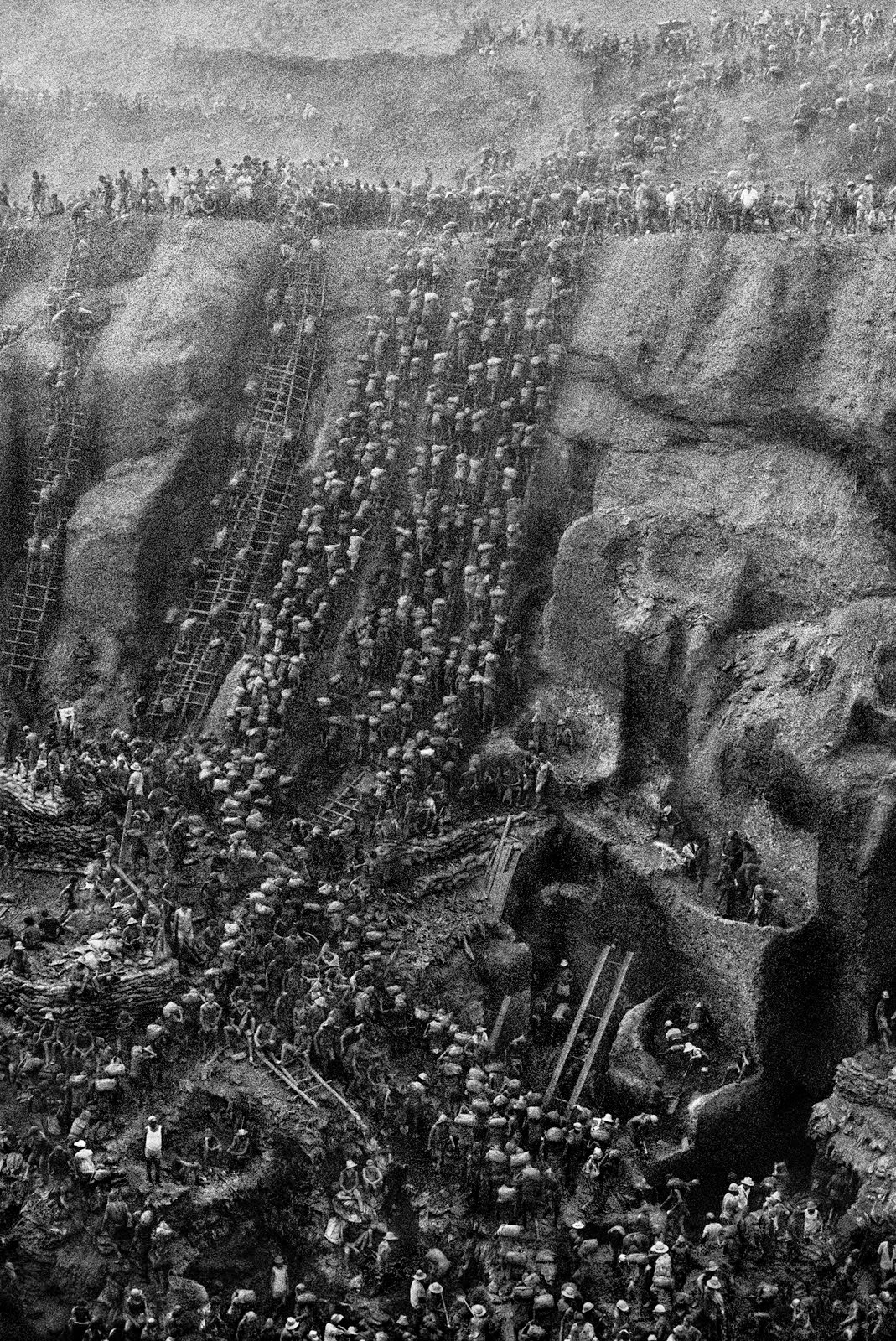
Take the 1986 photograph of the Serra Pelada gold mine taken by Sebastiao Salgado (pp.52&53) that document
 the enormity of the man-made mine, with carved-out hollows and terraces and long, rickety ladders leaning against its steep sides.  The packed crowd of miners, shifting their loads of earth, appears to move as one, in a continuous flow, like ants.It is an evocative image.

There is some overlap between the Capturing History series and Photos Framed which I found interesting and great for comparing the two.

Check out Tank Man: how a photograph defined China’s protest movement by Michael Burgan and p. 54 and 55 in Photos FramedTank Man  (the book) is full on – everything you need to know.  Photos Framed is much more cursory with just the basics for context.   The questions posed by each are interesting and, I think, complementary.  Photos Framed gives us three questions that make us analyze and deconstruct this specific image whereas Tank Man provides questions that take us beyond the image having us think about the implications, like the attitude of the protesters, understanding aspects of democracy, and the power of such an image.

I’m recommending both books for the middle grades (grades 5-9’ish) but I think students in high school would find these fascinating and very approachable.  Students working below reading level might feel less daunted but still come away with an increased understanding about significant moments in history and today’s world.


Monday, December 10, 2012

Scientific thinking


Far From Shore: Chronicles of anOpen Ocean Voyage by Sophie Webb is a detailed and quiet account of four months spent on a research ocean vessel collecting data about various marine animals (from plankton, various species of fish and tuna, dolphins and whales to sea birds).  The data collected will eventually be studied for many reasons but the primary purpose is to see whether populations of dolphins affected by purse-seine fishing have started to recover.

This four month journal certainly give us a good idea what it’s like to be a marine biologist/naturalist involved in such a research project.  Besides enjoying the beautiful water and wildlife, there are immense stretches of tedium, little privacy and down time from work (except when it storms or the ship stops for supplies at various ports).  Detailed descriptions of the ship’s layout and explanations of nautical and scientific terms are also included.

The author’s illustrations (completed while onboard) also give us visuals to show us what she sees as well as what she imagines. For example, the marine life that is below water is displayed to give us a sense of life at great depths, such as a sperm whale chasing squid or what  mixed school of tuna dolphins look like.

Geographic coordinates, scientific equipment, maps, charts and labelling of animal species all contribute to make this a good science book for middle grades.  Not a lot of excitement and drama to capture a student’s attention, but full of good information book about the nature of research on the open ocean.

Recommended. 

Monday, May 28, 2012

Cold cases heating up history

There’s nothing like a mystery or puzzle from times past to ‘engage those little grey cells’.  Whether you’re looking for something to engage students or to exercise their critical thinking skills, unravelling or delving into the stories behind mysteries might be one way to achieve this.


I’ve been revisiting Case Closed? : nine mysteries unlocked by modern science by Susan Hughes (902 HuC 2010) because it ties into a website that also enables students to investigate true historical, unsolved crimes.

But first, a recap of Case Closed?.  These nine mysteries are arranged more or less chronologically from oldest (around 1457 BC) to most recent  (1968): from the death and disappearance of Egyptian pharaoh, Hatshepsut to the inexplicable disappearance of a submarine enroute to Israel from England in the Mediterranean Sea.  Each case opens with a briefing about what is known about the circumstances surrounding the mystery plus possible reasons for the disappearance.  Maps, illustrations and photographs help present each case. Detailed information is provided about the research, including revisions to the hypotheses along the way, and finally, the most plausible explanation at the end.

I like this book because it shows the work that goes into uncovering a mystery, who’s involved (often teams of people from various backgrounds) and some of the science used.  The mysteries vary from the very well known to ones I was completely unaware of, including: a Chinese explorer, Hsu Fu around 215 BCE, the ancient Arabian city of Ubar, the Anasazi, the lost expedition of John Franklin, the murder, burial and possible survivors of the Romanov family in 1918, the mountain climber, George L. Mallory lost on Mount Everest in 1924, and the disappearance of an airplane in the Andes Mountains in 1974.

The website I came across is Great Unsolved Mysteries inCanadian History from the Department of Canadian Heritage and the University of Victoria.  These are fairly detailed accounts of cold cases from various time periods from Canada’s past.  There’s plenty of information about the people involved, the time period, newspaper articles, relevant documents such as court transcripts, interviews, photographs, and teacher support resources that include interpretations of the evidence.  Fascinating reading.  The cases include both the known and the obscure but are intriguing nevertheless once you start reading.  I love that primary documents are used to support the cases.  Most of the information is accessible without a login and password but to look at interpretations and teacher’s guides, you will need to have these which are free.

Both of these resources exercise historical thinking skills, which is part of the emphasis of the Alberta social studies curriculum.  Both could be used to model other cold cases from the historical record providing teachers and students a way to research information, interpret evidence and then present plausible explanations.


Check out Nonfiction Monday at Perogies & Gyoza for this week's roundup of nonfiction children's literature.

Monday, April 11, 2011

Hosting Nonfiction Monday

Welcome to Nonfiction Monday. 

This is a weekly round-up of blogs about children’s literature.  Through this venue, I’ve learned about some amazing resources over the last couple of years.  Please browse through the list following my posting and perhaps you, too, will find a book or two of interest.  If you wish to have your blog listed for today’s event, please leave your information in the comments box.  I have attached a Mr. Linky's Magical Widget for those of you who would rather use that (hopefully it works) and to be listed immediately.


My posting today is for Two Generals by Scott Chantler (940.5421 ChT 2010).
What a gem!

Right from the get-go, we are invited as readers to engage with this book as if it is/was someone’s personal journal.  The red ‘leather’ cover and black elastic band holding the covers together suggests that this is a field journal.  The title and cover illustration, two men (waist down only) in uniform, suggest a military story and the cemetery in the background tells us that this story will have grave and dire consequences.  This will be about war.

This nonfiction, graphic novel is an account of Scott Chantler’s grandfather’s experiences during the Second World War, as an officer with the Highland Infantry of Canada. We see a little bit about where Law Chantler comes from, what the 1920s and 30s were about (big band era, in case you’re wondering) and how it is that he comes to be fighting in a war halfway across the world.  Early on we meet Jack Chrysler, Law’s best friend who also enlists as an officer.

The story itself follows what most of us know about a soldier’s experience in the army at this time.  Hitler’s advance into Poland galvanized many young men into enlisting.  Law marries before shipping out.  Once in England it’s a lot of hurry-up-and-wait, in between a lot of intense and dangerous training preparing Law and Jack for Operation Overlord, “the largest military operation in history, the greatest display of might the world has ever known.” (p.59)  It’s big and it’s bloody. This is the battle to retake the French town of Buron.

 The end notes tell us how Scott Chantler came to write this narrative and the research he did to depict his grandfather’s experiences.  Mostly, it’s based on primary resources such as his grandfather’s journal from 1943, letters written by his friend Jack to Jack’s wife, the War Diary of the Highland Light Infantry of Canada for tactical information, various interviews with veterans and relatives of veterans, in addition to various secondary sources.

So, from all this great research comes the ‘story’ of one Lieutenant.  There is an ebb and flow to the narrative, starting with a war scene which suggests a battle having just been fought. An element of suspense is created as we see a lone officer standing in a body-strewn battlefield, his back to us, leaving us in doubt as to who has survived and who has not.  Between the training exercises we see lots of letter writing to those in Canada, establishing the importance of family, and hanging out with army buddies, playing cards, watching movies or chasing girls. The battle scenes are fraught with tension which is intensified by the colour red introduced whenever someone is injured, killed or in danger.

The illustrations are brilliant.  The colour scheme is almost monochromatic (black, white and military khaki) until Law begins to experience some of the violence to be expected in a war.  As mentioned above, red is used to underscore and convey the visceral impact this had on Law.  Time and again, we see him remembering different ‘bloody’ incidents, so we know he must have been haunted by them.  Perhaps, Law reflected on this in his journals or it may be that his grandson has taken the liberty of imagining how Law was affected by the war, as it turns out that Law never spoke to his family about his wartime experiences.

I think this kind of book, used in secondary classrooms, has great potential to bring home the ‘story’ of a soldier’s life during World War II, what was damaged and lost forever, in addition to illustrating what historical thinking is all about.  The research feels personal and obviously was important to the author.  This in itself is important – remembering our personal stories.
 

Monday, December 13, 2010

Citified

Last week I posted about Watch This Space, a kid’s book about the importance of public space in urban centres.  I got totally distracted by this book.  I really had started out to write about Metropolis : ten cities, ten centuries by Albert Lorenz (909 LoM 1996).


So…

I recommend that you give yourself lots of time when you crack the covers of Metropolis.  This is not a book to be rushed through.  An historical survey that is rendered in an oversized, pictorial format with an awesome amount of detail starting in 11th century Jerusalem, proceeding throughout Europe (Paris, Koblenz, Lisbon, Florence, Vienna, and London), parts of Asia (Osaka, Mongolian tent cities) and ending in 20th century New York City is a lot to take in.  The focus on each of these cities, at particular times, looks at significant events that had long-lasting or long-reaching effects.  (For example, we learn about the importance of the crusades across Europe and the Middle East by focusing on the epicentre, Jerusalem.) The cut-away cross-sections of buildings, aerial views and wide-angle perspectives of cities capture the many activities of everyday people.  A timeline frame on each 2-page spread keeps us in the loop of other significant events happening in other parts of the world.

Besides finding the informational content fascinating, I think this book would provide an interesting model for kids to follow when doing historical research about a time or place.   Visually representing historical research might be a way for some students show what they have learned.  This might be a different way to assess a student’s historical understanding.

If you’re a fan of the books A City Through Time or A Street Through Time then you will take particular pleasure in this book. I recommend it for grades 5 and up. 

And remember -- give yourself lots of time to enjoy.
https://blogger.googleusercontent.com/img/b/R29vZ2xl/AVvXsEgxtlxmIVR89JJmpLtgWyYtoLrxi0V6Asxax-sqpkFns8s8VGhB4ubjGmkfgWfZWKryBqG2Pex6NmOuyrxc0oUyVKUJfz7MnqjWlZX1B-7hEdZR-dz-s0jFsg54DS-EYoiOdZoktGpOZ3I/s1600/nonfiction.monday.jpg
Join Nonfiction Monday Roundup at books together  to see a list of recent blogs dedicated to highlighting nonfiction resources.

Sunday, July 18, 2010

The hunt is on! - Nonfiction Monday

"Research is a formalized curiosity.  It is poking around and prying with a purpose."  Zora Neale Hurston.

Ahhh, research…Can’t you just hear the students in your class hum in excited anticipation?  Oh boy, a research assignment… Can’t wait!  Right, maybe in some parallel universe.


I love research and always feel really badly about those students (university students becoming teachers who one day may have teach their own students research - oh, my) who become totally stressed and frustrated when it comes to having to conduct research.

So, this post isn’t going to be about new, fantastic strategies on how to do research or how to teach research, but begins a campaign to show students how much fun it is, how exciting it can be, and how relevant to everyday life (and not limited to just getting through school.)

A few really interesting books have come to my attention that have turned topics I know little about into gripping, fascinating mystery-like hunts for information.  These books demonstrate that research  has a purpose as well as a process.  Several of them read as real life mysteries.  And everyone loves a mystery, right?

Here are a few titles I’d strongly recommend:


1621 a new look at Thanksgiving / Catherine O’Neill and Margaret Bruchac (394.2649 GrN 2001)

-broadens our perspective of this national holiday

The Anne Frank case: Simon Wiesenthal’s search for the truth / Susan Rubin Goldman (940.5318 RUA 2009)
-a challenge is set to find the man responsible for the arrest of Anne, her family and others living in the Annex to help prove that Nazis were responsible for millions of deaths.

The boy who harnessed the wind: creating currents of electricity and hope / William Kamkwamba (621.312 KAB 2009)
-a young man with a desire to improve  life for people in his village with access to a small library and an incredible ability to create and overcome obstacles. Talk about research being relevant to everyday life!

Did Fleming rescue Churchill?: a research puzzle / James Giblin (823 G355D FIC)
-fictional account of a boy set to write a research essay at school who wants to use an 'interesting' anecdote - but is it true or not? And then what to do with it.

Hana’s suitcase: a true story / Karen Levine (940.5318 LEH 2002)
-a modern day hunt for the story behind an artifact (suitcase with Hana's name) sent by the Auschwitz Holocaust Museum to Tokyo.

The hive detectives: chronicle of a honey bee catastrophe  / Loree Griffin Burns (Scientists in the field series)
-researchers to save the day as they look to discover the reasons why bees are dying in droves

Left for dead: a young man’s search for justice for the USS Indianopolis / Peter Nelson (940.545973 NEL 2002)
-awesome set of circumstances where the movie Jaws motivates a young man to discover the real story behind an American WWII incident.

The mysteries of Beethoven’s hair / Russell Martin (780.92 MAM 2009)
-again, amazing accounting of the history of a lock of Mr. Bs hair that provides new information about the cause of his death.

The secret of the yellow death: a true story of medical sleuthing / Suzanne Jurmain (614.541 JUS 2009)
-we know how this ends, but it doesn't matter as the tension builds when doctors, scientists and volunteers place themselves at risk to discover the cause and antedote for yellow fever.

Tracking trash: flotsam, jetsam and the science of ocean motion / Loree Griffin Burns (Scientists in the field series) (551.462 BUT 2007)
-there's a lot of crap floating around in our oceans (besides oil) and this scientist takes us along to discover how things end up where they do.

Join Nonfiction Monday Roundup by clicking on the box below to go to
 In Needof Chocolate blog and see a list of recent blogs dedicated to highlighting nonfiction resources.
 Nonfiction Monday

Template Design | Elque 2007