Monday, December 29, 2014
Monday, December 22, 2014
The foodie edition
Okay, with Christmas just around the corner a good part of
my time is wrapped up with food – reading recipes, planning meals, grocery shopping, going out with friends for
meals, baking, eating, eating and more eating – you get the picture.
So, I got to thinking, what would a Christmas day meal look
like based on children’s books titles?
Here’s what I've come up with:
Dancing Pancakes (Spinelli)
OR Unlucky Charms (Rex)
Appetizers:
Nuts to You (Perkins)
AND/OR
Toads
on Toast (Bailey)
Christmas dinner:
Octopus
Soup (Mayer)
Tumbleweed Stew (Crummel)
Creepy Carrots (Reynolds)
Little Green Peas (Baker)
Mice and Beans (Ryan)
Dessert:
Ugly
Pie (Wheeler)
OR
Sweet
Dream Pie (Wood)
OR
Fortune Cookies of Weevil
(Reynolds) .
(I just couldn't make up my mind.)
And,
I’d serve Everything
on a Waffle (Horvath) – of course.
Not necessarily traditional Christmas fare but it would give guests lots to talk about.
How about you? Any
ideas for your perfect holiday meal?
Happy New Year, Everyone!
Posted by Tammy Flanders at 6:00 AM 1 comments
Labels: food, holidays, humour, novels, picture books
Monday, December 15, 2014
Welcome to my world
Follow my blog with Bloglovin
Really, I don't think this needs much explanation. Enjoy.
Don't you love the eyebrow action?
Posted by Tammy Flanders at 6:00 AM 0 comments
Labels: internet resources
Monday, December 8, 2014
A quick pick
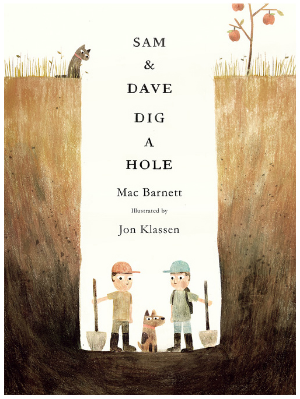
Sam & Dave dig a hole by Mac Barnett , illustrated by Jon Klassen
has been getting lots of good press and being a fan of Jon Klassen (see I want my hat back and This is not my hat) I was eager to read it.
And, now it has finally arrived in the Doucette Library.
I can remember
wanting to dig to China when I was very young and thought it was on the other
side of the world, having no clue as what that entailed geographically speaking. I could be there in no time – a mere morning
of digging and I’d be there. An early
desire to see more of the world foreshadowed here, perhaps.
And this ties into the premise of this picture book. Two boys and a dog, decide to dig a
hole. Which they do. But when do they stop? They are on a mission and won’t stop until
they find something ‘spectacular’.
Sounds exciting, doesn't it?
I wonder how far they’ll have to dig?
I wonder what they’ll discover?
The reader’s anticipation is tapped into as we’re allowed to
‘see’ what the boys are almost about to uncover – but then don’t! ARGH!
Don’t you just hate when that happens?
The wryness of the text with the deadpan expressions of the characters
all play into the understated humour of the story.
However, the dog who must have extra super-dooper, spidey
senses, does seem to know where the treasures are -- showing us the potential for
success. The boys who blithely go about
their digging business are oblivious to the dog’s extrasensory perception.
So, down and down and down they go, missing several
increasingly large-sized diamonds along the way, strategizing as they go
(change directions, splitting up) and hoping that soon they’ll strike the mother lode.
Where will it all ends?
This isn't so clear cut as it may seem. The ambiguous ending leaves us guessing as to whether the boys have dug themselves back home or if they've fallen into an almost exact replica of home, some kind of alternative universe, maybe.
It’s easy to enjoy this gem, which is all the better for not
having to dig even one spade’s worth of dirt.
Recommended for grades K to 3.
Posted by Tammy Flanders at 6:00 AM 2 comments
Labels: humour, picture books, pleasure reading
Monday, December 1, 2014
Art with a story
Migrant by Jose Manuel Mateo and Javier Martinez Pedro is
an intriguing bilingual (English/Spanish) accordion-style folding book that
looks to generate awareness about children who take huge risks in trying to
enter the United States illegally, either alone or with their families.
In this story, short narratives from a child’s perspective accompany
specific sections of the unfolding mural-like codex. In the beginning life is good, with people in
the village leading hard but fruitful, peaceful lives growing crops for a
landowner. But things change when some
of the men leave to find work.
Eventually, the father of the boy telling the story also leaves the
village, sending money back home occasionally.
But when the money stops coming and the mother finds it too difficult to
survive in the village without work, she makes the decision to leave as well.
The main part of the story is the journey to reunite with
the father. The family travels long distances and takes great risks jumping on
trains, scaling walls, and evading police, capture and ‘disappearing’, all
along way until they arrive outside Los Angeles. Here they will find jobs cleaning houses and
search for the father.
The art work is what predominates here. Nine panels ‘unfold’ this story in black and
white illustrations with exacting detail that fills up every panel. For example, the village scene is packed with
people, vegetation, animals, houses, mountains, a starry sky and a beaming
sun. We can see the watermelons, maize,
and papayas being grown and harvested from the fields, while the bordering sea
provides fish and fun. It’s a bustling
place.
In the artist’s note he tells us that he is following in the
artistic tradition of the Mexican state of Guerrero and the work does have a
folk art feel. However, I was also reminded of Peter Sis’s illustrations, as
well, with tiny details conveying a multitude of life’s minutiae. Our main character is discernible by the
distinctive cap that he wears so the reader is able to keep track of him in each section (though I did have to hunt a couple of times).
The book is gorgeous, striking and provocative. It conveys a child’s sense of home, fear,
excitement, hopefulness and home-sickness.
The illustrations express the movement of people and the tension that
such a situation naturally produces. One
review I read suggested looking at this book panel-by-panel and I would agree
with this for the first reading. But do
open up the whole book, otherwise you’ll miss seeing the patterns of ‘lines’
that convey the sense of movement. You
have to spend time with this book. It’s
not a ‘quick read’.
Reviews are suggesting that young children are the target
audience for Migrant but I would disagree. The amount of detail, the black and white
illustrations and the content of the story would be too much for the primary
grades, in my opinion. You could have
young children track the protagonist throughout the story but then the point of
the story would be misdirected. If a
child has been through a similar journey, then they would have some context for
the story and this might work. The actual written story would be easily
understood but I think the illustrations wouldn't hold young readers attention.
I’m recommending this book for older students, grades 9 and
up, who would derive more from the whole book and would likely have the staying
power required to work through and revisit the story. However, a co-worker thought that grades 5/6 could use it to model their own work on.
For extra interest, try pairing this with Tsunami by Joydeb Chitrakar another accordion-style
narrative about the 2004 tsunami that devastated vast areas of coastline in Southeast
Asia. I blogged about this one back in 2010.
Posted by Tammy Flanders at 6:00 AM 0 comments
Labels: geographical thinking, immigrants, journey, picture books, social issues, travel
Monday, November 24, 2014
Visual literacy: Power of a photo
Right off the bat, I have to fess up to loving the series
Captured History and Captured World History.
I've blogged about one of the books, Migrant Mother by Don
Nardo a while back, in fact.
And I'm immensely grateful that the publisher (Compass Point Books) has branched out into world history with their latest offerings.
These books focus on iconic photographs that have had an
impact on the viewing public, changing and forming public opinion about social
issues such as migrant workers during the American Depression era, about child
workers in the early 1900s, the cost of
war, specifically the American civil war, the environment, and international
politics to name but a few.
They are organized following a basic format: rudimentary background about the ‘moment’ to
set up the image, in-depth historical
information about the period,
information about the photographer, his/her work and what was happening when
he/she took the photograph and then, what lasting impact the image has had.
Also included are timelines, glossary, reading lists, internet resources,
bibliography, index, and a few critical thinking questions.
These real-life stories really get you into the picture
you’re looking at, establishing context so that we can understand why the photo
was and often still is important and what were the implications for social
change.
So, have I convinced you that these series are worth
checking out?

Another recent arrival in the Doucette Library is PhotosFramed: a fresh look at the world’s most memorable photographs by Ruth Thomson.
It does a similar job focusing on notable images (27 of them
to be precise). These are organized into
groupings according to the intent of the photo.
Categorized as portraits, nature, art, and documentary, each section displays several photographs
that range over time. For example,
Portraiture includes an 1844 image of Louis Daguerre who produced the first
permanent photograph, a 1949 of Pablo Picasso, Che Guevara in 1960, Afghan girl
in 1985, and the Royal Wedding of Prince William and Kate Middleton in 2011.
Each photo is accompanied by a preceding page that contains
information about the photograph, the photographer, two boxed commentaries that
zoom in on very specific aspects of the image, and three questions to make the
viewer think a little more deeply about this image.
For example, when viewing the famous National Geographic
1985 photo of a refugee Afghan girl we are asked to think about:
*How does the girl’s direct stare make you feel?*How might the effect of this photograph have differed if the photographer had taken a wider shot?*If you had to put this photograph into a category, with would you choose: portrait or documentary or both? Why?
I found this book fascinating because it did include so many
images, many that I was unfamiliar with, so I could browse. The point of memorable images is that they
draw you in, make you wonder what the story is, and then revisits you time and
again.
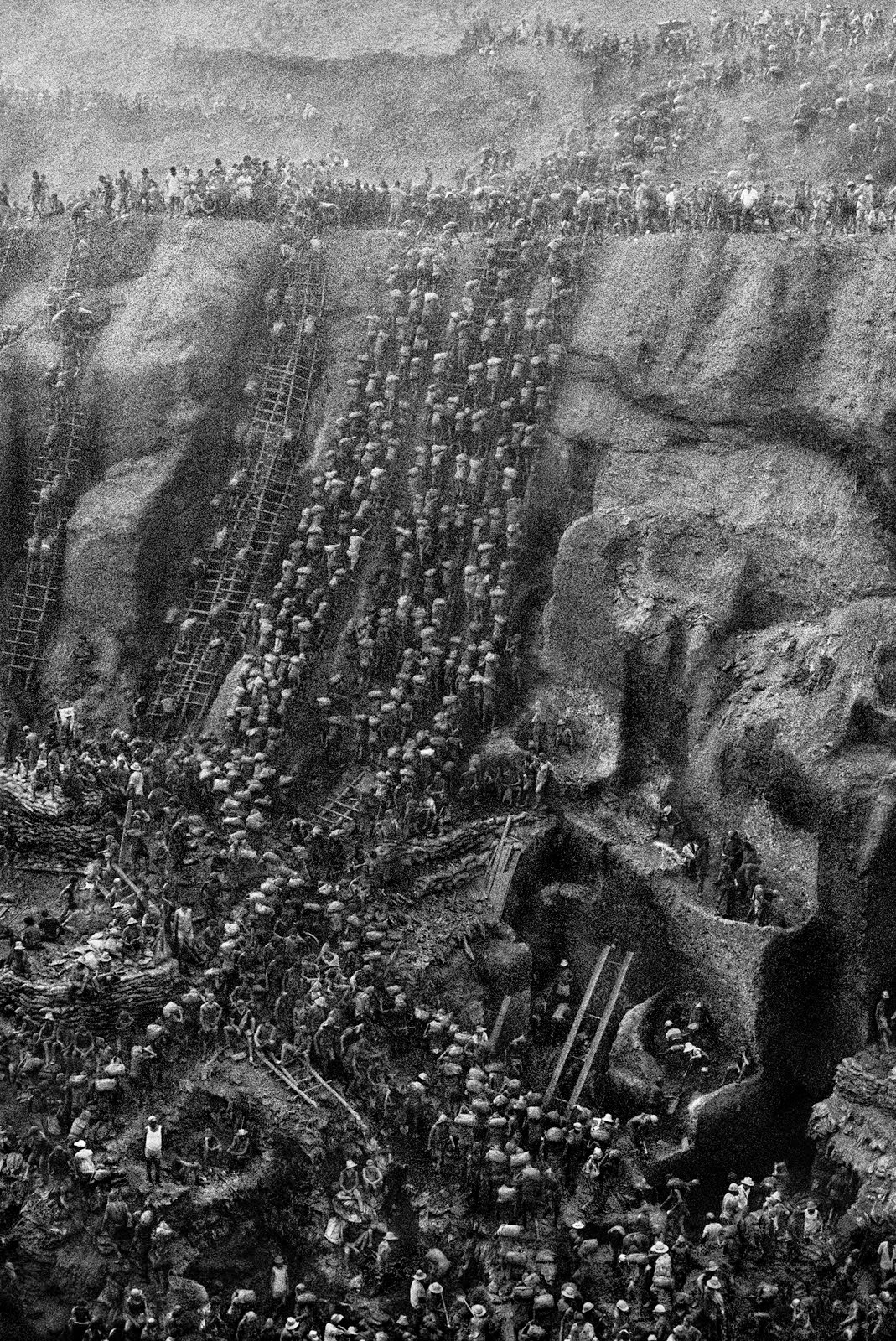
Take the 1986 photograph of the Serra Pelada gold mine taken
by Sebastiao Salgado (pp.52&53) that document
the enormity of the man-made mine, with carved-out hollows and terraces and long, rickety ladders leaning against its steep sides. The packed crowd of miners, shifting their loads of earth, appears to move as one, in a continuous flow, like ants.It is an evocative image.
There is some overlap between the Capturing History series
and Photos Framed which I found interesting and great for comparing the two.
Check out Tank Man: how a photograph defined China’s protest movement by Michael Burgan and p. 54 and 55 in Photos Framed. Tank Man (the book) is full on – everything you need to
know. Photos Framed is much more cursory
with just the basics for context. The
questions posed by each are interesting and, I think, complementary. Photos Framed gives us three questions that
make us analyze and deconstruct this specific image whereas Tank Man provides
questions that take us beyond the image having us think about the implications,
like the attitude of the protesters, understanding aspects of democracy, and
the power of such an image.
I’m recommending both books for the middle grades (grades 5-9’ish) but I think students in high school would find these fascinating and
very approachable. Students working
below reading level might feel less daunted but still come away with an
increased understanding about significant moments in history and today’s world.
Posted by Tammy Flanders at 6:00 AM 0 comments
Labels: historical thinking, photographic books, research, social issues, social studies, visual literacy
Subscribe to:
Posts (Atom)